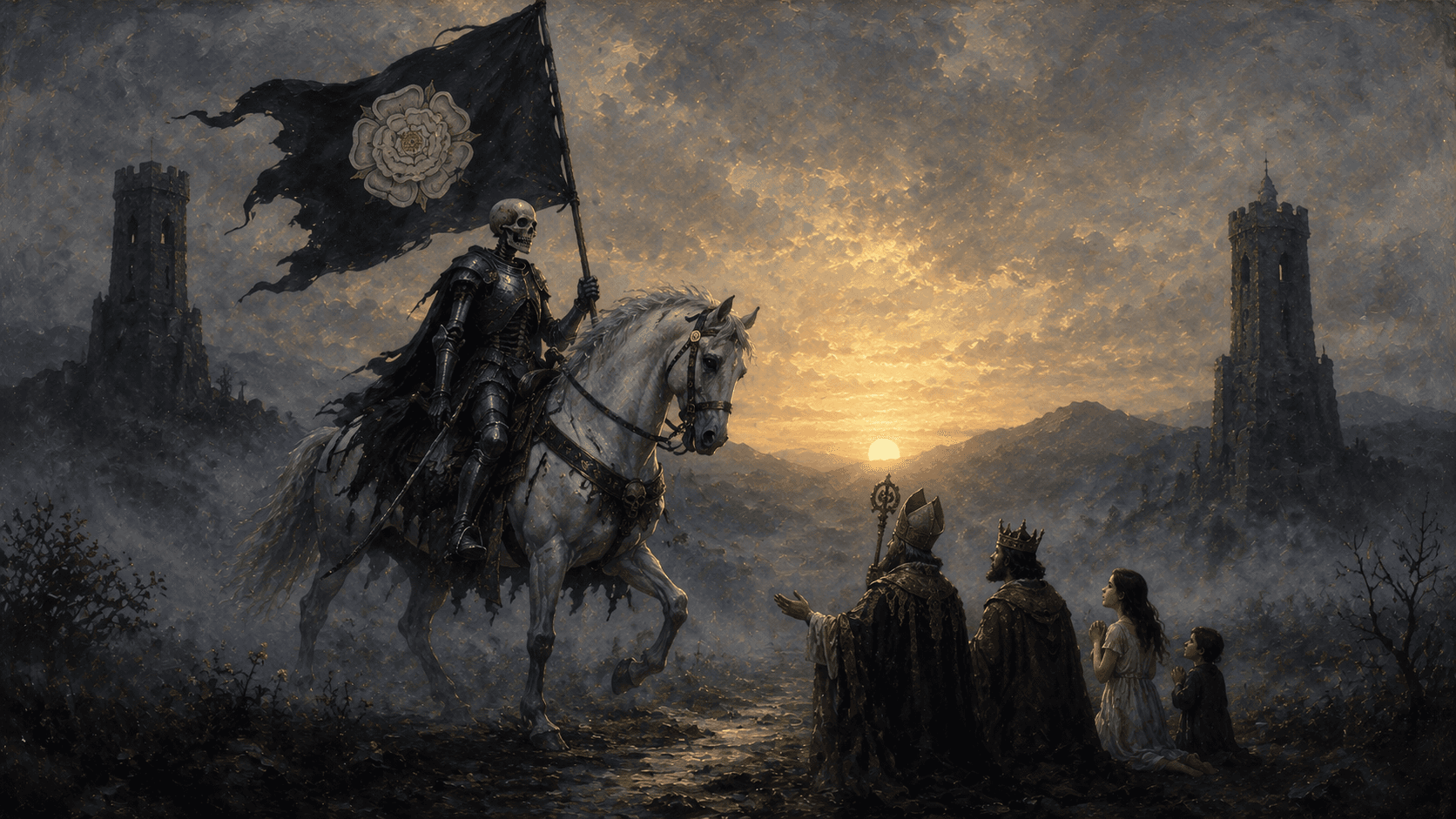
When the Death card appears in a reading, many people freeze. The image is stark — an armored skeleton mounted on a white horse, a black flag raised bearing a white rose, figures of a king, a bishop, a young maiden, and a small child standing in its path. A sun rises between two towers in the distance. It is not a subtle card. And because the name and imagery are so direct, it tends to produce a reaction before it is ever interpreted. That reaction is almost always fear, and almost always unnecessary.
The Death card rarely refers to literal death in a reading context. This is not wishful thinking or a softening of the card's meaning — it is a reflection of how the card has been understood within the Rider-Waite-Smith tradition. The tarot is a symbolic system, and Death is one of its most powerful symbols: not of an ending in the physical sense, but of transformation so complete that what came before cannot continue in its current form. It is the card of the threshold, of the necessary close.
What the RWS imagery is actually showing you
Look closely at the card. The skeleton — Death — is in full armor, which in the RWS tradition signals invincibility and inevitability. The white horse it rides is a symbol of purity and unstoppable forward motion. The black flag with its white rose is significant: black for the ending, white for the purity of what it clears away, and the rose itself — a symbol of beauty that blooms precisely because of the cycle of death and renewal. Nothing here is punishing. Everything is in motion.
The figures in the path are telling. The king lies fallen — power and authority are not exempt from change. The bishop faces Death with hands raised, negotiating or praying, but unable to stop what is coming. The maiden looks away or faints, unable to witness the transition. And the child looks up, openly, without terror — in the RWS tradition, children often represent the part of the psyche that is closest to truth, and here the child alone meets Death with something approaching curiosity. Between the two towers in the background, the sun rises. It always rises. The image itself encodes the answer to its most common misreading: this is not the end of everything. It is the end of something, and beyond it, the light continues.
The Death card does not arrive to tell you something terrible is coming. In the Rider-Waite-Smith tradition, it arrives to tell you something is already over — and that your reading may be asking you to finally acknowledge that.
What Death means upright in a reading
When Death appears upright, the Rider-Waite-Smith tradition reads it as a profound transition — an ending that is both real and necessary. This is not about loss for its own sake. It is about the release of something that has already run its course: a relationship that has quietly become something other than what it was, a phase of life that has been over for longer than you have let yourself admit, a version of yourself that no longer fits. The card's appearance in this position tends to point toward a threshold that has already been reached, whether or not it has been stepped through.
There is also a quality of irreversibility in Death upright that distinguishes it from cards like The Tower, which describes sudden rupture, or The Wheel of Fortune, which describes cyclical change. Death in this tradition asks you to recognize that what is ending cannot be resumed. That is not necessarily a painful thing. In some readings, this card arrives with a quality closer to relief — the acknowledgment that something has been holding you in place, and that its ending makes room for something new to take root.
The Death card reversed
Reversed, the Death card in the RWS tradition does not simply invert the upright meaning. It does not mean 'no transformation' or 'good news.' The reversed position tends to describe resistance — a clinging to what has already passed, an inability or unwillingness to complete the transition that the upright card would demand. What is over is being held onto. What needs to be released is being kept. The transformation is not prevented by the reversal; it is delayed, or avoided, often at significant cost.
This can manifest in many ways in a reading. It might point toward a situation being prolonged past its natural end, a habit of revisiting what no longer serves, or a fear of the unfamiliar that makes the familiar — even the painful familiar — feel safer. The reversed Death card is not a warning of doom. It is an invitation to examine what you are still carrying from something that has, in many essential ways, already concluded.
Reversed, Death asks a precise question: what are you holding that has already let go of you?
Why Death is one of the most important cards in a spread
The Death card is numbered XIII in the Major Arcana, and it sits at the center of the Fool's progression through the trumps. It follows The Hanged Man — the card of suspension, of voluntary pause — and precedes Temperance, the card of integration and measured flow. That placement is not incidental. In the architecture of the Major Arcana, Death is the point at which something fundamental shifts: you cannot continue as you were. What follows is not chaos, but the slow, careful work of Temperance, of finding new balance. Death, in this structural reading, is the hinge.
When this card appears in a reading, it tends to carry weight precisely because it is not ambiguous. Many cards in the tarot invite multiple interpretations, hold tensions between possibilities. Death does not. It is clear about what it names. That clarity can feel uncomfortable, but it is also one of the most useful things a reading can offer — a card that does not hedge, that simply points to the transition that is already underway.
A note on literal death in a reading
It would be dishonest to claim the Death card never touches the literal. In rare contexts, and almost always in conjunction with other cards in the spread, a reader working in the RWS tradition might consider whether physical mortality is part of what is being surfaced. But this is genuinely rare, and the far more likely reading — in the vast majority of spreads where Death appears — is symbolic transformation. If this card has come up in your reading and you are sitting with that question, let the rest of the cards in your spread speak. A single card does not carry a full message. The Death card is asking something of you, and that something is almost certainly about what you are ready to release.
The child in the image has the right idea. Looking up, open, not turning away — there is something in that posture worth borrowing. What the Death card names is rarely what we fear it names. And what it actually names — the end of what no longer fits, the threshold between what was and what is becoming — is something the reading is offering you as clarity, not as threat.