What the card shows
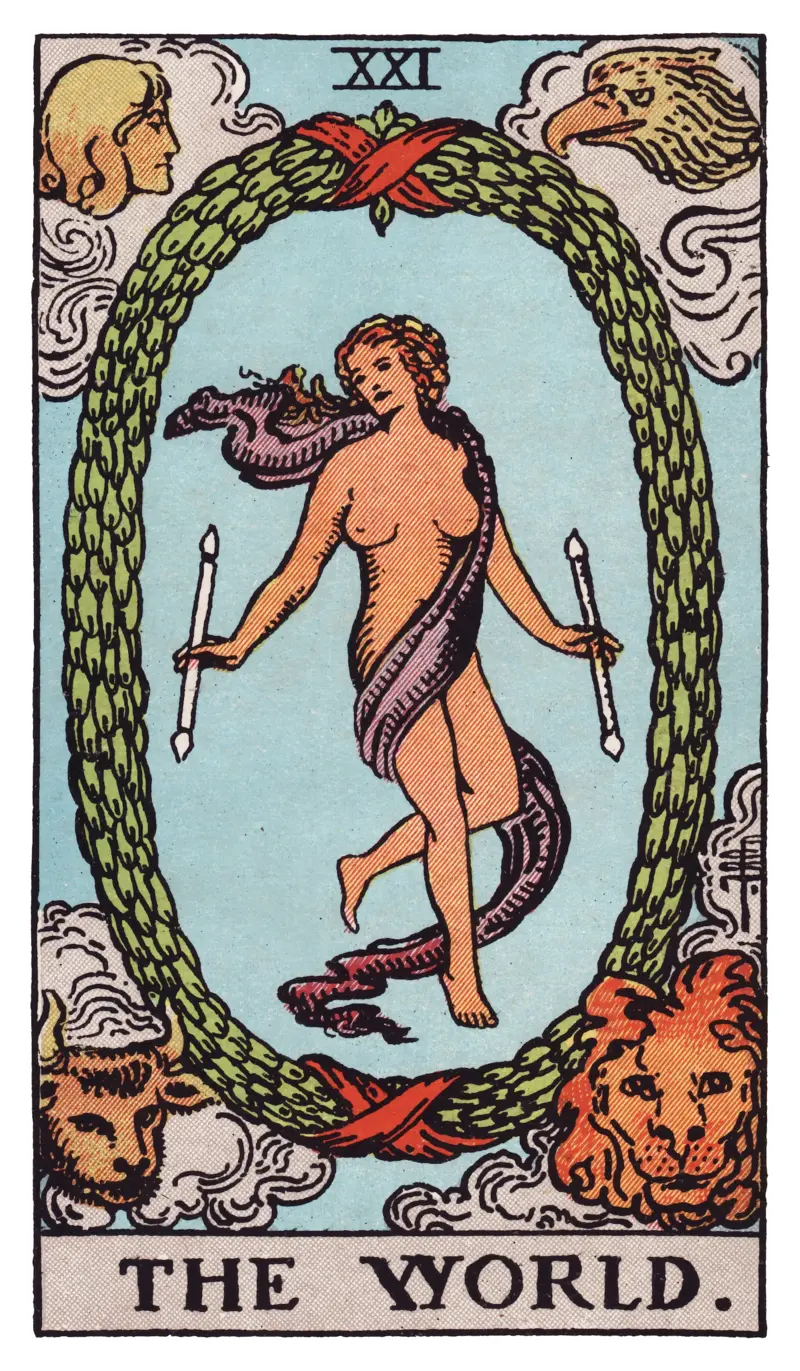
The World of the Rider-Waite-Smith deck shows a dancing figure within an oval wreath, a baton in each hand, surrounded by the four winged beings — angel, eagle, lion, and bull — at the corners.
Upright vs reversed
| Upright | Reversed | |
|---|---|---|
| Keyword | COMPLETION | INCOMPLETION |
Upright meaning
In the Rider-Waite-Smith tradition, The World is read as the card of completion — not merely an ending but the closing of a full circle, the recognition that a long arc has been finished in a way that integrates the experience rather than discarding it. Waite framed the figure within the wreath as a sign of integration achieved, not perfection imagined. Practitioners often read this card as a sign that the question is being asked at the resolution of a substantial chapter, and that what has been learned along the way is now part of who the reader is.
The four winged beings at the corners — the same as on the Wheel of Fortune — are associated in modern RWS commentary with the stable elements that frame the completed circle: the experience has happened in a real world, with real conditions, and now occupies its proper place. As an upright card, The World is most often interpreted as the counsel to recognize completion when it arrives, to allow oneself to mark it, and to let the next cycle begin from this earned ground rather than from a constant restarting.
Reversed meaning
Reversed, The World is traditionally read as completion not yet claimed: a chapter that is essentially finished but is being held open out of fear, an unfinished thread the reader has not addressed, or — in some readings — the work done but the integration still pending. Waite associated the reversal with stagnation and inertia at the threshold of the new; many modern practitioners read it as a prompt to ask what small piece of acknowledgment is still owed to what has actually been completed.
In a reading
In a situation position, The World is often read as naming a context defined by the closing of a long cycle. In an action position, it is interpreted as a call to acknowledge what is finished, to let the work integrate, and to begin the next chapter from solid ground. In an outcome position, the card is commonly read as a wholehearted completion — the kind that earns the reader the right to begin again.
In combination
The World and The Fool together are read as the most complete statement of the cycle in the Major Arcana — conclusion meeting the threshold of the new beginning, the last card meeting the first. The tradition reads this combination as the purest form of cyclical completion: one chapter truly finished, and the next genuinely available. The World with The Sun names a fullness the tradition reads as the great affirmation: achievement and joy, integration and abundance. When The World appears with Judgement, the tradition reads the pairing as the final movement of the Major Arcana: the reckoning and summons resolved into wholeness and completion.
Frequently asked questions
- What does The World mean in a love reading?
- In a love reading, The World is read as fulfillment and completion within the relational dimension — the sense of wholeness that a relationship has brought, or the integration of the lessons that love has offered across the full arc of what has been experienced. For some, it names a relationship that has arrived at genuine maturity. For others, it names the completion of a chapter that allows a new one to be entered with greater wholeness.
- What does The World mean in a career reading?
- In a career reading, The World is among the most positive possible outcomes: it names completion, integration, and the achievement of what was set out to accomplish. The tradition reads it as genuine mastery and recognition — not the aspiration toward these things but their arrival. Modern practitioners sometimes note that The World in a career reading does not only name an endpoint; it names the quality of integration that comes from having seen something fully through.
- What does The World reversed mean?
- Reversed, The World is traditionally read as the completion deferred — the last steps to wholeness being avoided, or the sense of conclusion that is close but not yet arrived. Modern practitioners sometimes read it as a fear of completion itself, the delay of finishing what has almost been finished because ending is its own kind of threshold. In some readings, the reversed position names a cycle genuinely stuck in its final phase.
These notes follow the Rider-Waite-Smith tradition. They describe what the card is associated with — not predictions about your life.