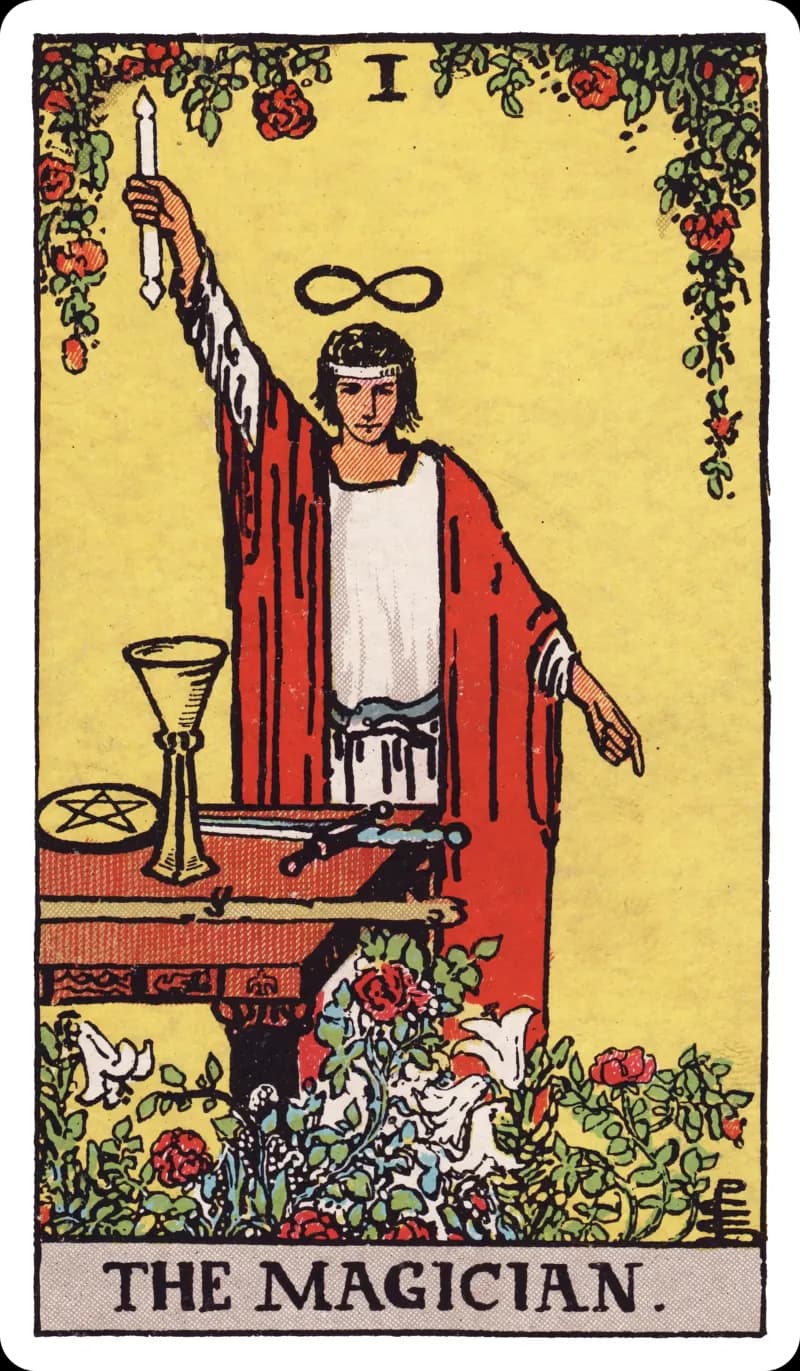
What the card shows
The Magician of the Rider-Waite-Smith deck shows a robed figure standing before a table on which the four suit emblems — wand, cup, sword, and pentacle — are laid out, one hand raised toward the sky and the other pointing to the ground.
Upright vs reversed
| Upright | Reversed | |
|---|---|---|
| Keyword | MANIFESTATION | MANIPULATION |
Upright meaning
In the Rider-Waite-Smith tradition, The Magician is read as the card of focused will — the moment in which intention, skill, and material meet and become capable of producing a result. Waite described the figure's posture as the channel between what is above and what is below, and the table as the workbench where the four elements are arranged for use. Practitioners often read this card as a sign that the reader has the tools required for the question being asked, even when the inventory of those tools is not obvious.
Modern RWS commentary tends to frame The Magician less as supernatural power and more as agency: the discipline of choosing what to act on, the craft of arranging what is already at hand. The infinity symbol above the figure's head is associated with the continuous practice through which mastery is built. As an upright card, it is typically interpreted as readiness to act, not the action itself.
Reversed meaning
Reversed, The Magician is traditionally read as the gap between intention and follow-through — talent that has not been organized, communication that misleads (including self-deception), or skill applied to the wrong task. Waite associated the reversed card with disquiet and weakness of will; many modern practitioners read it as a prompt to examine where one's tools are being scattered or directed away from the question that actually matters.
In a reading
In a situation position, The Magician is often read as naming a moment when the reader's resources and the question are aligned. In an action position, it is interpreted as a call to choose deliberately and to act with the tools already on the table. In an outcome position, it is commonly read as a result that follows from focused effort rather than chance.
In combination
The Magician and The High Priestess together are read in the RWS tradition as the balance between outward action and inward knowledge — will meeting wisdom, or the question of whether to act before one has truly listened. The Magician with Strength names focused will alongside disciplined patience: the ability to sustain effort without forcing. When The Magician appears with The Tower, the tradition often reads it as skill applied to a structure that was never going to hold — with resourcefulness still available for what comes next.
Frequently asked questions
- What does The Magician mean in a love reading?
- In a love reading, The Magician is commonly read as deliberate intention applied to a relationship — the decision to act on what is already known rather than wait for better conditions. The card names agency more than passion. RWS practitioners often read it as the moment when someone in a relationship chooses to work on it, or when a new connection becomes possible because the reader has decided to make it so.
- What does The Magician mean in a career reading?
- In a career context, The Magician is among the most directly action-oriented cards in the Major Arcana. The tradition reads it as confirmation that the tools required for the task at hand are already present, even if they are not all visible at once. Modern RWS commentary often frames it as the card of skilled execution — not inspiration or luck, but the disciplined application of what one already knows how to do.
- What does The Magician reversed mean?
- Reversed, The Magician is traditionally read as talent or resource that has been scattered, misdirected, or turned toward manipulation. Waite associated the reverse with disquiet; modern practitioners often read it as a prompt to examine whether the skills being applied are the right ones for the actual question — or whether impressive-sounding activity is standing in for genuine effort.
These notes follow the Rider-Waite-Smith tradition. They describe what the card is associated with — not predictions about your life.