What the card shows
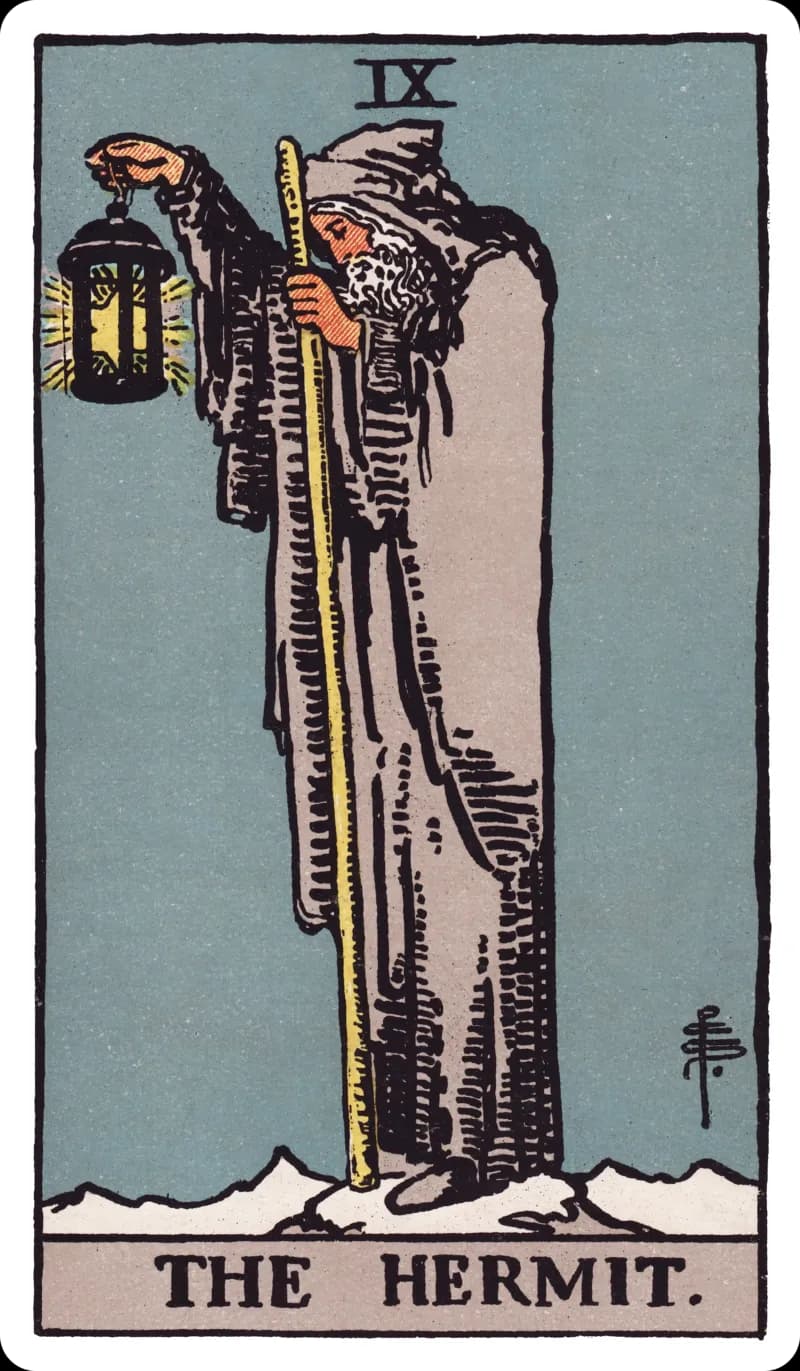
The Hermit of the Rider-Waite-Smith deck shows a robed figure standing alone on a snowy peak, holding a six-pointed star within a lantern in one hand and leaning on a long staff with the other.
Upright vs reversed
| Upright | Reversed | |
|---|---|---|
| Keyword | INTROSPECTION | ISOLATION |
Upright meaning
In the Rider-Waite-Smith tradition, The Hermit is read as the card of chosen solitude — the deliberate step away from noise in order to see by a smaller, steadier light. Waite described the lantern not as a beacon for the crowd but as a private illumination, carried by someone who has gone apart to look more carefully. Practitioners often read this card as a sign that the question calls for inward attention rather than for outward consultation, and that the answer is more likely to be found in retreat than in another conversation.
The mountain setting is associated in modern RWS commentary with elevation as perspective: not loftiness above others, but the distance one needs from the daily ground to see its shape. The Golden Dawn correspondence to Virgo grounds the card in themes of careful examination and discernment. As an upright card, The Hermit is most often interpreted as the counsel to slow down, narrow the field, and look inward with patience.
Reversed meaning
Reversed, The Hermit is traditionally read as solitude that has tipped into either isolation or its avoidance: withdrawal from what should be faced, or — at the other extreme — refusal to take the inward time the question requires. Waite associated the reversal with concealment and unwarranted retreat; many modern practitioners read it as a prompt to examine whether the reader is hiding or, conversely, refusing to make space for honest reflection.
In a reading
In a situation position, The Hermit is often read as naming a moment that asks for inward focus rather than action. In an action position, it is interpreted as a call to step back, take counsel of one's own light, and let the answer surface in quiet. In an outcome position, the card is commonly read as a clarity reached through patient solitude.
In combination
The Hermit and The High Priestess together form one of the most interior pairings in the Major Arcana — both associated with inward knowledge, silence, and the cultivation of what cannot be rushed. The tradition often reads this combination as a deep call to interior work rather than external action. The Hermit with The World names a completion arrived at through long, often solitary, cultivation — the mastery that comes from sustained, deliberate practice. When The Hermit appears with The Fool, the tradition sometimes reads it as the question of whether the step forward is ready to be taken, or whether another period of inner preparation is still needed.
Frequently asked questions
- What does The Hermit mean in a love reading?
- In a love reading, The Hermit is most often read as a period of necessary solitude — time that a relationship needs for one or both parties to return to their own center before the connection can be renewed or deepened. The tradition does not read this as retreat from relationship as failure; it reads it as the kind of withdrawal that makes genuine meeting possible. In some readings, the card names a relationship that has become too enmeshed, and calls for the individuation that healthy connection requires.
- What does The Hermit mean in a career reading?
- In a career reading, The Hermit is often read as a period of deep focus, deliberate withdrawal from collaboration, or the choice to work in depth rather than in breadth. RWS practitioners frequently read it as a sign that what is needed is concentrated inner work rather than external activity — research, reflection, or the kind of solo effort that cannot be done in a group. The card can also name a mentor or advisor who holds wisdom accumulated over long, often solitary, practice.
- What does The Hermit reversed mean?
- Reversed, The Hermit is traditionally read as isolation that has gone past what is nourishing — withdrawal that has become avoidance, self-sufficiency that has become a refusal of the connections the reader actually needs. Some practitioners also read it as the failure to share what has been learned through long inner work, the lamp kept hidden rather than raised.
These notes follow the Rider-Waite-Smith tradition. They describe what the card is associated with — not predictions about your life.