What the card shows
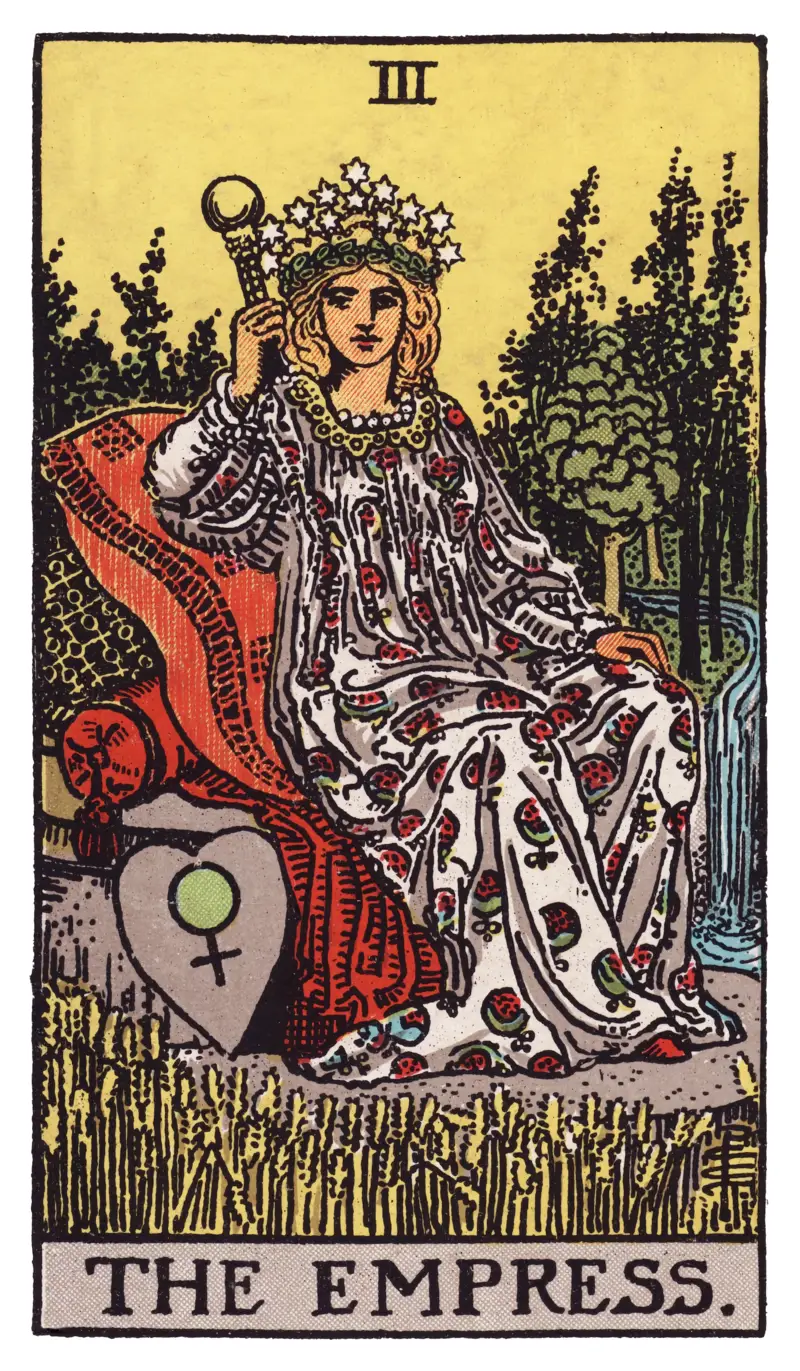
The Empress of the Rider-Waite-Smith deck shows a crowned figure seated on a cushioned throne in a field of ripe wheat, surrounded by a garden, with a heart-shaped shield bearing the symbol of Venus at her side.
Upright vs reversed
| Upright | Reversed | |
|---|---|---|
| Keyword | ABUNDANCE | DEPENDENCE |
Upright meaning
In the Rider-Waite-Smith tradition, The Empress is read as the card of generative life — what grows, what nourishes, what is brought into being and tended. Waite associated her with the natural world and with the productive force that follows after will, and the wheat at her feet is the tradition's image of harvest as the result of patient cultivation. Practitioners often read this card as a sign that the question concerns something being made or tended over time, rather than something to be decided in a single moment.
The Venus symbol on her shield links the card to themes of love, beauty, and embodied presence as understood in Western esoteric practice. Modern RWS commentary tends to broaden these themes: creative work, mothering in the widest sense, the relationship between the body and what one builds. As an upright card, The Empress is usually read as fertile ground — a season in which what is planted has the conditions to take root.
Reversed meaning
Reversed, The Empress is traditionally read as care that has gone out of balance: depletion from over-giving, growth blocked or stalled, the body or the project neglected for too long. Waite associated the reversal with vacillation and difficulty in domestic affairs; many modern practitioners read it as a prompt to ask where the source of nourishment has been left untended, including the reader's own.
In a reading
In a situation position, The Empress is often read as naming a setting in which something is growing — sometimes obviously, sometimes quietly. In an action position, it is interpreted as a call to tend rather than to push, to attend to the conditions of growth rather than the speed of it. In an outcome position, the card is commonly read as fruition, the harvest of what has been cultivated.
In combination
The Empress and The Emperor together are read in the RWS tradition as the complementary pair of generative and structural forces — what grows alongside what orders. The combination is often read as a call to balance creative or nurturing impulses with clear form and boundary. The Empress with The Moon names a more interior combination: creative depth meeting the unknown, or fertility emerging from a place that has not yet been fully lit. When The Empress appears with The Star, the tradition tends to read it as one of the most straightforwardly hopeful pairings: the conditions for growth present alongside the orientation toward renewal.
Frequently asked questions
- What does The Empress mean in a love reading?
- In a love reading, The Empress is among the most consistently positive cards in the RWS tradition — associated with sensual connection, nurturing, and the kind of love that sustains rather than consumes. For someone in a relationship, it is often read as a season of deepening care and mutual growth. For someone seeking a relationship, it is frequently read as fertile ground: the conditions for connection are present, and the reader is in a position to tend them rather than force them.
- What does The Empress mean in a career reading?
- In a career reading, The Empress most often names creative work, generative output, or a project that is in a phase of growth rather than completion. The tradition associates the card less with business strategy and more with productive care — the period in which steady attention to the work is the right action. It is also sometimes read as a workplace dynamic that has become nurturing or collaborative, or as a prompt to attend to creative aspects of one's professional life that have been underfed.
- What does The Empress reversed mean?
- Reversed, The Empress is traditionally read as care that has gone out of balance — over-giving without replenishment, growth that has stalled because conditions have not been tended, or creative output that has dried up from neglect. Many modern practitioners read the reversal as a direct prompt to ask where the source of nourishment — creative, relational, or physical — has been left untended.
These notes follow the Rider-Waite-Smith tradition. They describe what the card is associated with — not predictions about your life.