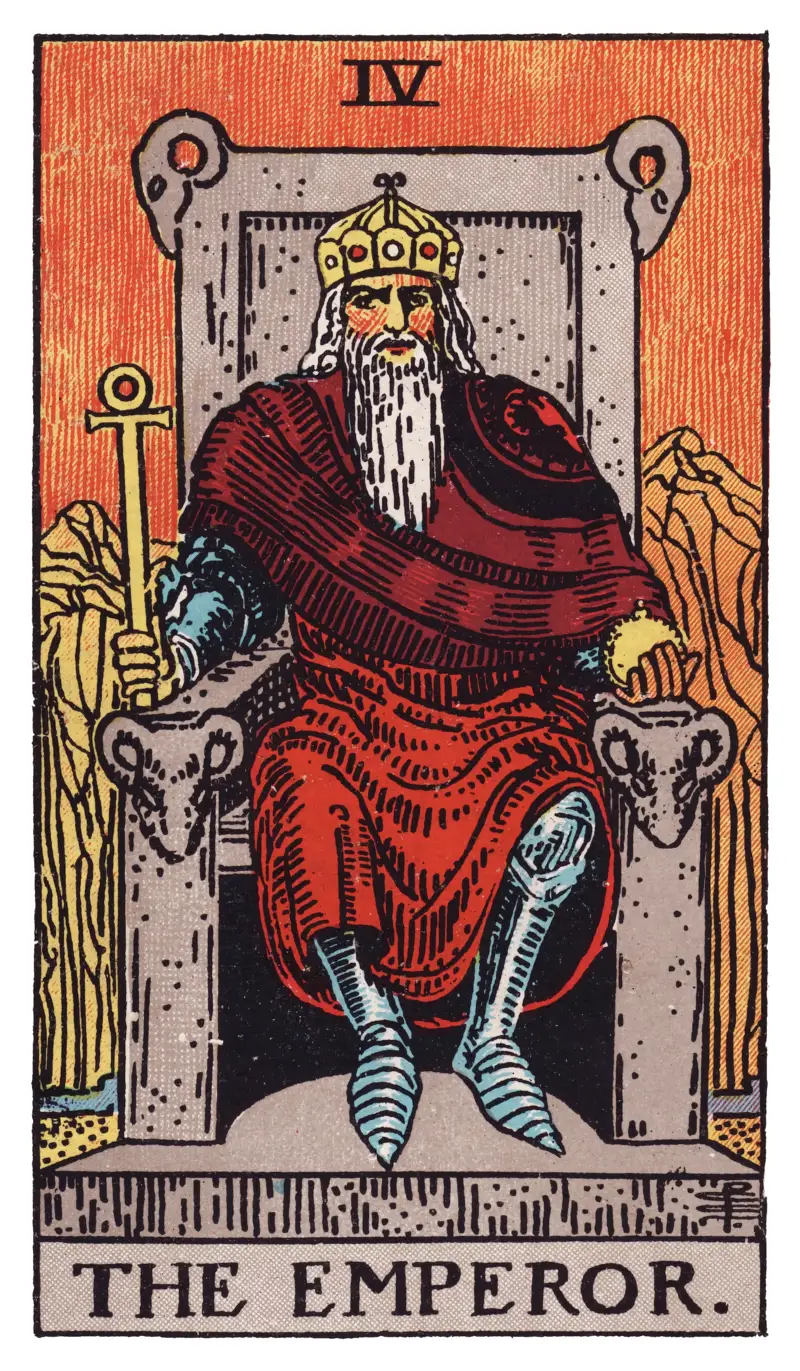
What the card shows
The Emperor of the Rider-Waite-Smith deck shows a stern figure seated on a stone throne adorned with rams' heads, holding an ankh-shaped scepter and an orb, in a barren mountain landscape.
Upright vs reversed
| Upright | Reversed | |
|---|---|---|
| Keyword | STRUCTURE | RIGIDITY |
Upright meaning
In the Rider-Waite-Smith tradition, The Emperor is read as the card of structure: the rules, frames, and offices through which raw possibility is organized into something that can be governed and trusted. Waite paired him with The Empress as a complementary force — where she is generative and tending, he is ordering and protective. Practitioners often read this card as a sign that the question turns on form rather than impulse: how a plan is built, how authority is exercised, how a boundary is held.
The mountain landscape and rams' heads — sometimes linked in Golden Dawn correspondences to Aries — are associated with steadiness under pressure and with leadership exercised on principle rather than on mood. Modern RWS commentary tends to read The Emperor as discipline in service of others, not domination for its own sake. As an upright card, he is most often interpreted as a call to make commitments concrete, to give shape to what has been amorphous.
Reversed meaning
Reversed, The Emperor is traditionally read as authority become brittle or absent: rigidity that no longer protects, control mistaken for care, or — at the other extreme — abdication, a frame that has been allowed to collapse. Waite associated the reversal with a failure of compassion in command; many modern practitioners read it as a prompt to examine where structure is serving the structure itself rather than the people inside it.
In a reading
In a situation position, The Emperor is often read as naming a setting governed by an existing order, for better or worse. In an action position, it is interpreted as a call to set rules, build frames, and stand by commitments. In an outcome position, the card is commonly read as a stable arrangement that holds — provided the reader is willing to maintain it.
In combination
The Emperor and The Empress together are read in the RWS tradition as the structural and the generative in dialogue — form and growth, boundary and flow. The tradition does not consistently favor one over the other; the question the combination raises is whether the two are in balance or at odds. The Emperor with The Hierophant names institutional authority doubled: both cards associated with established order, and the combination often reads as a moment when systems and structures are particularly defining the situation. When The Emperor appears with The Tower, the tradition reads the meeting as structure meeting disruption — the question of whether what has been built will withstand or shatter.
Frequently asked questions
- What does The Emperor mean in a love reading?
- In a love reading, The Emperor most often names the introduction of structure, commitment, or clearly defined expectation into a relationship. The tradition reads the card as the question of whether the relationship has form. Some practitioners read it as a dominant or authority-oriented partner; others read it simply as the need for both parties to know where they stand. Reversed, its appearance in love often points to rigidity or control where flexibility would serve better.
- What does The Emperor mean in a career reading?
- In a career reading, The Emperor is one of the most clearly positioned cards in the Major Arcana: it names authority, leadership, and the structural organization of work. RWS practitioners commonly read it as confirmation that taking a clear position — making the decision, establishing the frame, choosing the direction — is the right action. It can also name an organization or superior who exercises significant authority over the situation.
- What does The Emperor reversed mean?
- Reversed, The Emperor is traditionally read as structure that has become rigidity, authority that has outrun its usefulness, or control that is no longer serving the order it claims to maintain. Modern practitioners often read the reversal as a prompt to examine where rule-following has replaced genuine judgment — or, in some readings, where the reader has abdicated their own authority to an external system.
These notes follow the Rider-Waite-Smith tradition. They describe what the card is associated with — not predictions about your life.