What the card shows
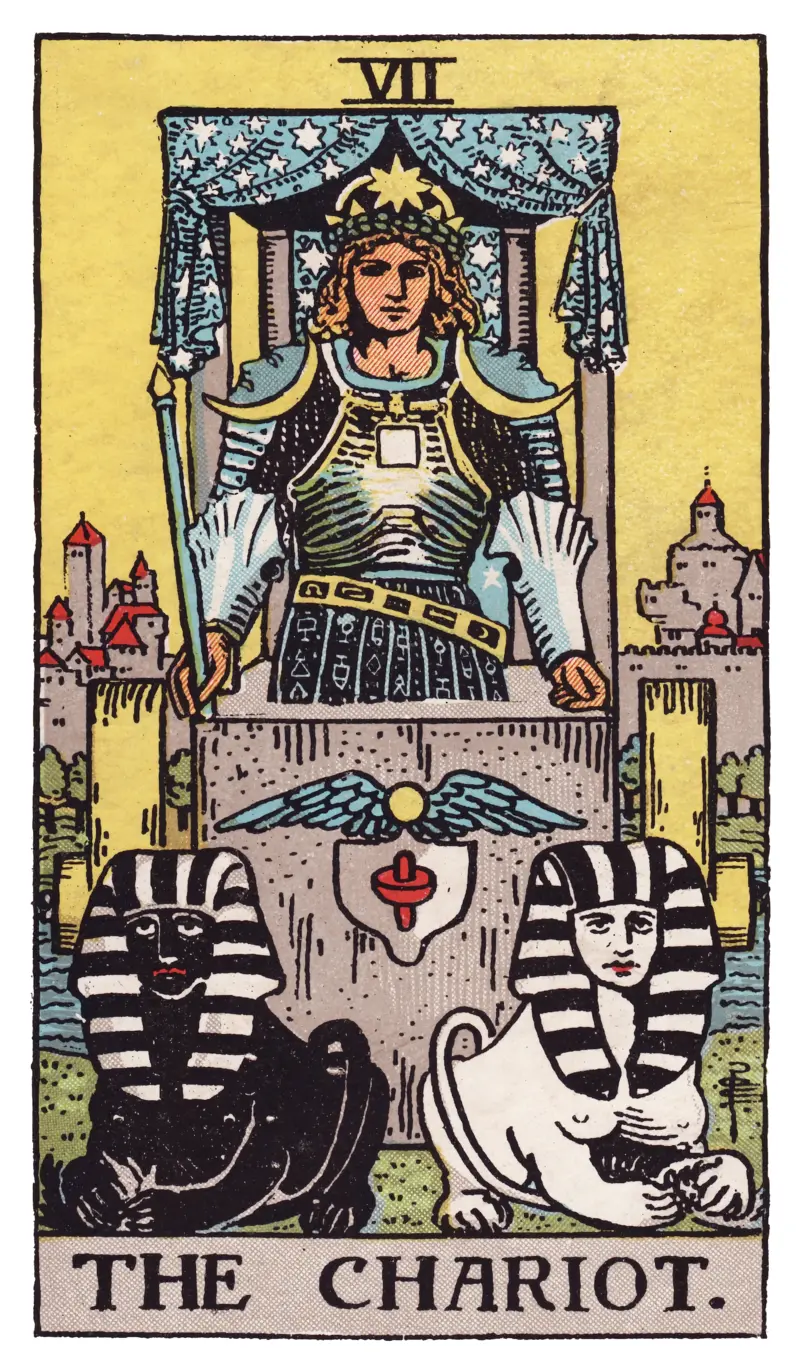
The Chariot of the Rider-Waite-Smith deck shows an armored figure standing in a stone chariot drawn by two sphinxes — one black, one white — beneath a starry canopy, holding a wand rather than reins.
Upright vs reversed
| Upright | Reversed | |
|---|---|---|
| Keyword | WILLPOWER | LOSS OF CONTROL |
Upright meaning
In the Rider-Waite-Smith tradition, The Chariot is read as the card of disciplined movement: forward motion held together by will rather than by ease. Waite emphasized that the figure carries no reins — the team is governed by the driver's command alone, which makes the card a study of inner authority. Practitioners often read this card as a sign that the question turns on the reader's ability to hold a direction across opposing pulls without being torn by them.
The two sphinxes, one black and one white, are associated in Golden Dawn correspondences with paired opposites that must be coordinated rather than chosen between. Modern RWS commentary tends to read The Chariot as victory through composure — not the absence of conflict, but the integration of conflicting forces under a shared direction. As an upright card, it is most often interpreted as a green light for moving forward, contingent on the reader's willingness to remain at the helm rather than be carried.
Reversed meaning
Reversed, The Chariot is traditionally read as movement that has lost its driver: forward force without coherence, opposing pulls treated as enemies rather than as a team to coordinate, or — at the other extreme — a willful push in a direction that no longer serves. Waite associated the reversal with defeat and unethical victory; many modern practitioners read it as a prompt to ask whether the reader is steering or merely being pulled.
In a reading
In a situation position, The Chariot is often read as naming a setting that calls for steady command of competing pressures. In an action position, it is interpreted as a call to choose a direction and hold it, attending to balance rather than to force. In an outcome position, the card is commonly read as a hard-earned victory secured by composure.
In combination
The Chariot and Strength together are read in the RWS tradition as two distinct modes of overcoming: The Chariot through directed external force, Strength through patient inner presence. The combination often raises the question of which mode the situation actually requires. The Chariot with The Wheel of Fortune names a dynamic the tradition reads carefully — will meeting chance, the directed path encountering the turn it did not plan for. When The Chariot appears with The Emperor, the combination is often read as executive authority in motion: structure and directional force aligned.
Frequently asked questions
- What does The Chariot mean in a love reading?
- In a love reading, The Chariot is less about the connection itself and more about the determination to pursue or maintain it. The tradition reads the card as focused will in action. For ongoing relationships, it often names a period when sustained effort is what is needed. The card also sometimes appears when a relationship is being tested by external pressure, and names the reader's capacity to hold a course despite opposition.
- What does The Chariot mean in a career reading?
- In a career reading, The Chariot is one of the most clearly directional cards: it names forward movement through sustained will and focus. RWS practitioners commonly read it as confirmation that the direction is right and that pressing forward is the appropriate action. The two sphinxes in the card's imagery are read as opposing forces held in harness: the card is not about the absence of tension but about the ability to direct it.
- What does The Chariot reversed mean?
- Reversed, The Chariot is traditionally read as the will that has lost its direction — scattered effort, aggression without aim, or determination that has become obstinance. Modern practitioners often read it as a prompt to ask whether the force being applied is actually driving toward the intended destination, or whether momentum has become an end in itself.
These notes follow the Rider-Waite-Smith tradition. They describe what the card is associated with — not predictions about your life.