What the card shows
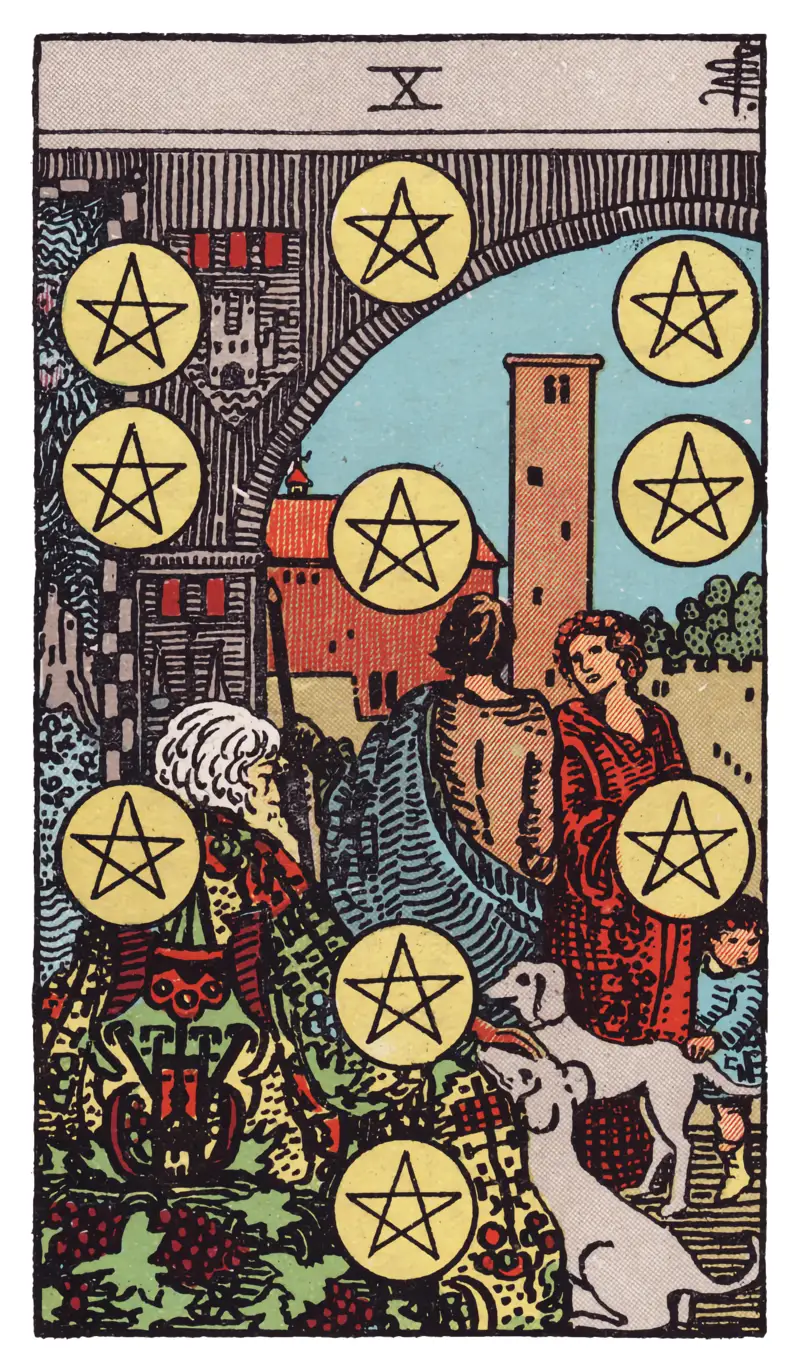
A white-haired elder sits beneath an archway as a couple and young children stand nearby in conversation; two dogs rest at the elder's feet, and ten pentacles are arranged overhead in the pattern of the Kabbalistic Tree of Life, linking the entire scene to a tradition older than the family itself.
Upright vs reversed
| Upright | Reversed | |
|---|---|---|
| Keyword | LEGACY | FAMILY STRAIN |
Upright meaning
In the Rider-Waite-Smith tradition, the Ten of Pentacles is read as the culmination of material achievement extended across generations — not personal wealth alone, but the wealth of lineage, tradition, and the structures one leaves behind. Waite associated the Tens with completion and the fullness of a suit's expression, and in Pentacles that fullness is the family estate, the multigenerational enterprise, the community institution that outlasts its founders. The ten pentacles arranged in the Kabbalistic Tree of Life pattern are among the most deliberate of Waite's choices: they signal that this material abundance is rooted in a spiritual and ancestral framework that transcends the individual. The elder under the archway is the embodiment of what has been passed down; the couple and children represent what it will become.
Contemporary RWS practitioners read the Ten of Pentacles as the card of legacy in the most practical sense — not an abstraction but the actual inheritance, the family home, the business that has been handed down, the pension, the estate, or the community network that supports its members across time. The card is also read in smaller contexts: a family business that is thriving, a household that has achieved genuine stability, or a way of living that has taken generations to build and is now mature enough to sustain itself. Practitioners often note that the presence of the dogs and children gives the card warmth that the purely financial reading can miss.
Reversed meaning
Reversed, the Ten of Pentacles signals disruption to the legacy — inheritance disputes, family wealth lost through poor decisions, a tradition that is being broken rather than honored, or the suffocating weight of expectations that come with belonging to an established lineage. The tradition reads this reversal as the failure of transmission: what was meant to be passed down has been squandered, withheld, or corrupted. Practitioners also read it as a warning against equating financial inheritance with emotional or relational inheritance — one may arrive without the other.
In a reading
In the Situation position, the Ten of Pentacles identifies a context of established material structures — family, legacy, institution, or long-standing community wealth that forms the backdrop of the current question. In the Action position, it counsels honoring what has been built rather than dismantling it carelessly, while examining whether the inherited structure still serves those within it. In the Outcome position, it points toward lasting material security — an outcome that will endure beyond the immediate moment.
In combination
The Ten of Pentacles beside The Emperor is read in the RWS tradition as legacy meeting law — the family estate and the ordering authority that maintains it, stability compounded into institution. Paired with the Four of Wands, the reading warms considerably: the established household as the site of genuine celebration, the archway framing a homecoming. When the Ten of Pentacles appears with The Fool, practitioners often read the generational tension the suit saves for last — the heir at the edge of the estate, deciding whether the inheritance is a foundation or a fence.
Frequently asked questions
- What does the Ten of Pentacles mean in a love reading?
- In a love reading, the Ten of Pentacles is traditionally read as a bond considered in its longest frame — family, permanence, and the structures two people build beyond themselves. For someone in a relationship, it often names questions of lasting commitment: a shared home, families woven together, a life designed to endure. For someone single, it can describe the weight of family expectation on the heart's choices, or a wish for love with foundations. The card thinks in generations, not evenings.
- What does the Ten of Pentacles mean in a career or money reading?
- In career and money questions, the Ten of Pentacles usually names established structures — inheritance, property, a family enterprise, a pension, or long-accumulated security that forms the backdrop of the question. The tradition reads the Tree of Life arrangement as wealth rooted in something older than any individual. The card interprets rather than advises — it does not direct decisions about estates or investments. It asks whether the inherited structure still serves the people living inside it.
- What does the Ten of Pentacles reversed mean in a reading?
- The Ten of Pentacles reversed is traditionally read as the legacy disrupted — disputes over inheritance, family wealth strained by poor decisions, a tradition breaking rather than being honored, or the suffocating weight of expectations that come with an established lineage. Practitioners also read a quieter warning in it: financial inheritance and emotional inheritance are not the same thing, and one may arrive without the other. The reversal names a failure of transmission, not a verdict on the family itself.
These notes follow the Rider-Waite-Smith tradition. They describe what the card is associated with — not predictions about your life.