What the card shows
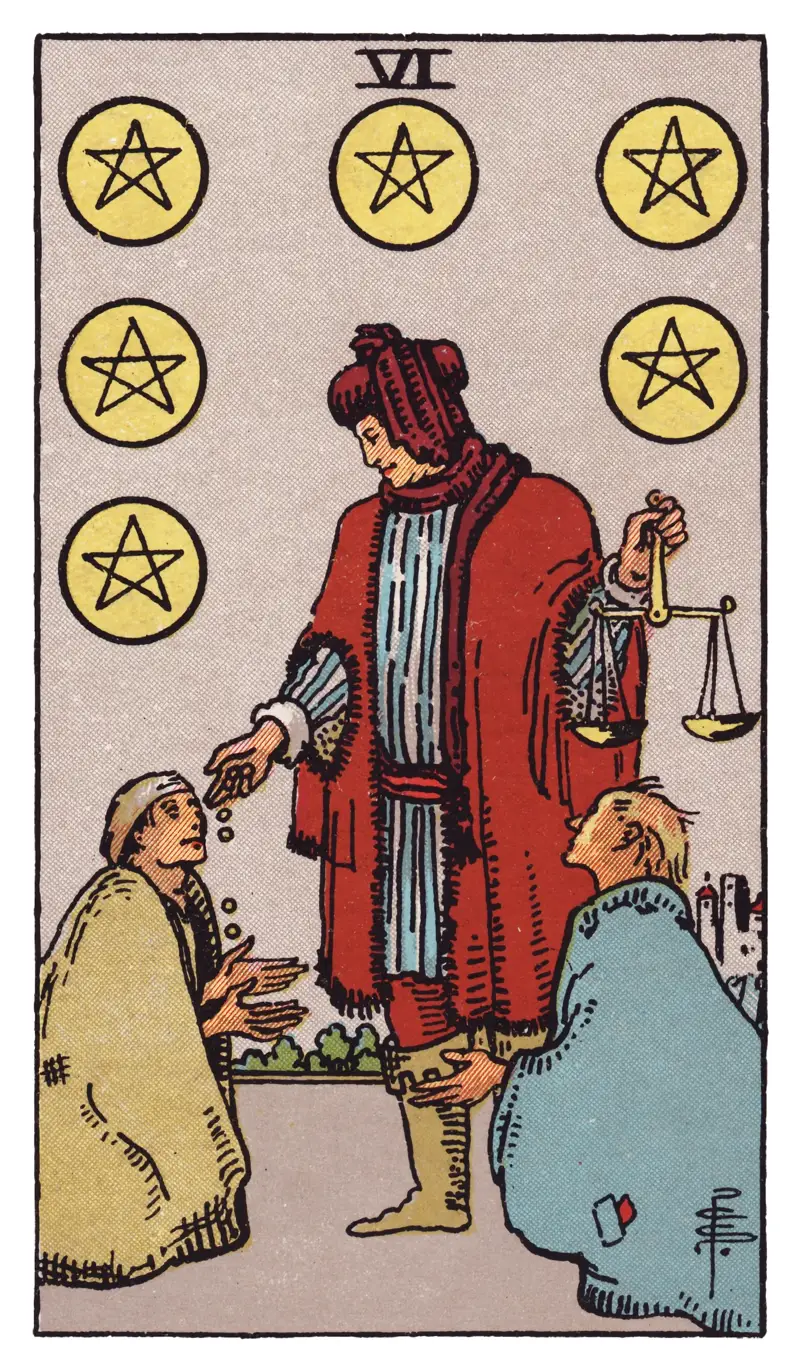
A well-dressed merchant stands between two kneeling figures in ragged clothing, holding a balanced scale in one hand and dispensing coins from the other; six pentacles float overhead in an even arrangement.
Upright vs reversed
| Upright | Reversed | |
|---|---|---|
| Keyword | GENEROSITY | STRINGS ATTACHED |
Upright meaning
In the Rider-Waite-Smith tradition, the Six of Pentacles is read as the card of material generosity in transaction — the moment when resources flow from those who have them to those who need them, mediated by the balance of fair exchange. The scale in the merchant's hand is the card's defining object: it signals that this giving is measured, not impulsive, and that equity rather than charity is the operative principle. Waite associated the Sixes with harmony following disruption, and in Pentacles that harmony is expressed as a redistribution of material resources within a social structure. The kneeling figures receive, the standing figure distributes — but the tradition resists reading this as a simple hierarchy; the scale insists that the exchange is being judged against a standard of fairness. Practitioners often note the ambiguity of the card's power dynamic: the giver holds the scale, and thus controls the measure.
Contemporary RWS readers bring a more layered reading to the Six of Pentacles, noting that generosity and power are entangled in the card's imagery. The card is read as a positive omen when it describes charity given or received in good faith, fair wages, the repayment of a debt, or the arrival of financial support from an institution or patron. It is read more cautiously when it describes a relationship in which one party controls the terms of the giving. Practitioners frequently use this card to open a conversation about the difference between transactional generosity — giving with conditions — and genuine material solidarity.
Reversed meaning
Reversed, the Six of Pentacles points to an imbalance in how resources are being distributed — generosity withheld, a debt unpaid, or charity given with strings attached that compromise the dignity of the recipient. The tradition also reads the reversal as possible exploitation disguised as beneficence: the scale is no longer level, and one party is benefiting disproportionately from the arrangement. Practitioners sometimes read the reversed Six as a warning to examine who controls the terms of an exchange currently underway.
In a reading
In the Situation position, the Six of Pentacles describes a material exchange — financial support given or received, a transaction in progress, or a redistribution of resources within a relationship or institution. In the Action position, it counsels measured generosity: giving within one's actual means, receiving without shame, and paying attention to whether the exchange is genuinely equitable. In the Outcome position, it points toward a resolution of material imbalance — resources finding their appropriate level.
In combination
The Six of Pentacles beside Justice is read in the RWS tradition as the informal scale meeting the formal one — an exchange whose fairness is about to be weighed against a standard beyond the giver's hand. Paired with the Five of Pentacles, the two cards complete each other's sentence: the need outside the window and the measured help that could answer it. When the Six of Pentacles appears with the Four of Pentacles, practitioners often read the argument between circulation and hoarding — resources asked to move by one card and gripped by the other.
Frequently asked questions
- What does the Six of Pentacles mean in a love reading?
- In a love reading, the Six of Pentacles is traditionally read as a question about balance in giving — who provides, who receives, and who holds the scale that measures the exchange. In a relationship, it can name genuine mutual support, but practitioners watch its power dynamic closely: care given with conditions is not the same as care. For someone single, it may describe a pattern of over-giving or of accepting less than parity. The card invites an honest audit of the terms.
- What does the Six of Pentacles mean in a career or money reading?
- In career and money questions, the Six of Pentacles usually names an exchange of resources — fair wages, a debt repaid, support from an institution or patron, or generosity extended within one's actual means. The tradition reads the merchant's scale as the operative symbol: equity, not charity, is the standard being applied. The card interprets rather than advises — it does not direct anyone to give or borrow. It asks whether the exchange underway is genuinely level, and who controls its measure.
- What does the Six of Pentacles reversed mean in a reading?
- The Six of Pentacles reversed is traditionally read as the scale tipping — generosity withheld, a debt left unpaid, or giving that carries strings which compromise the dignity of the one receiving. Practitioners also read it as exploitation dressed as beneficence: one party benefiting disproportionately from an arrangement that presents itself as fair. The reversal directs attention to the terms of the exchange — who set them, who audits them — rather than predicting any particular loss.
These notes follow the Rider-Waite-Smith tradition. They describe what the card is associated with — not predictions about your life.