What the card shows
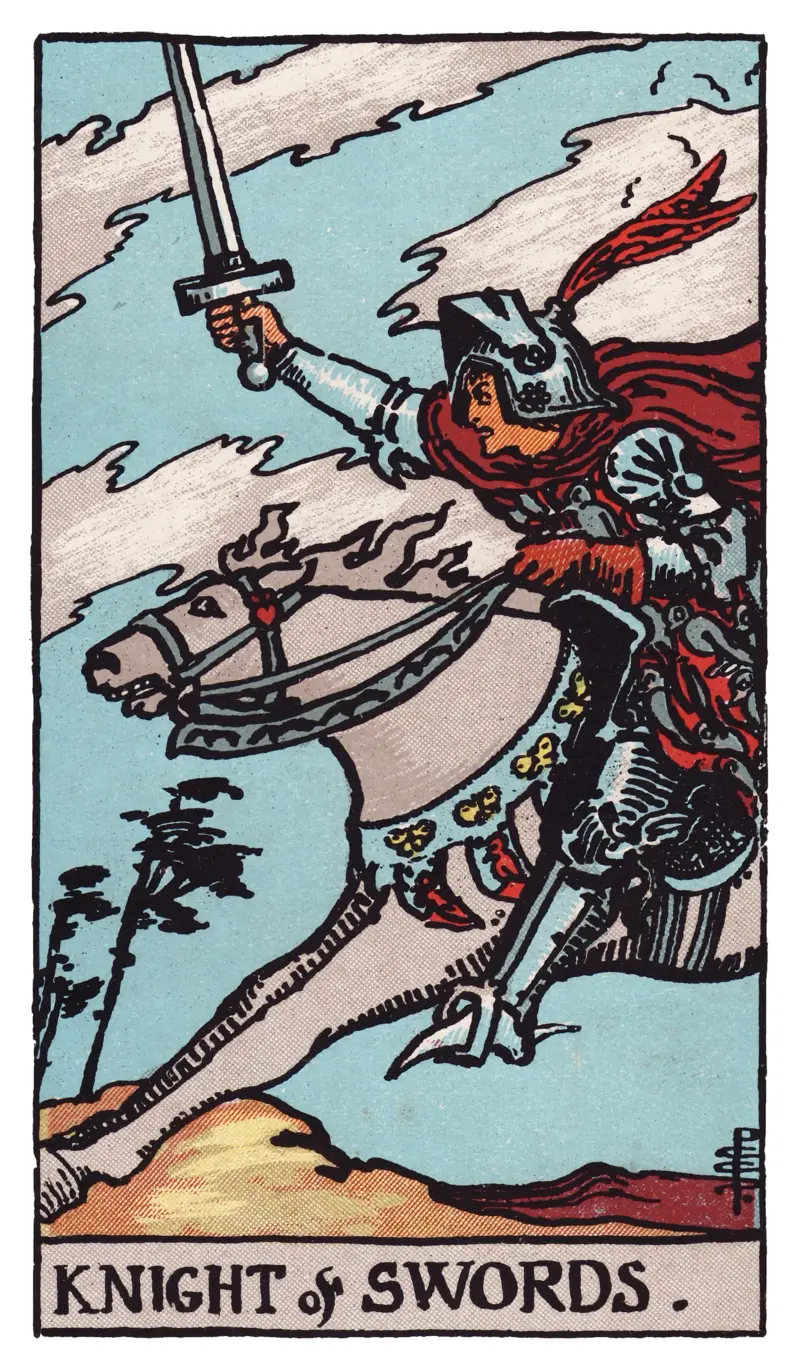
A fully armored knight charges forward on a galloping white horse, sword extended ahead and upward in a gesture of total commitment; the trees behind bend violently in the wind and storm clouds race overhead, the entire scene animated by forward motion.
Upright vs reversed
| Upright | Reversed | |
|---|---|---|
| Keyword | DRIVE | RECKLESSNESS |
Upright meaning
In the Rider-Waite-Smith tradition, the Knight of Swords is read as the embodiment of mental force in full forward motion — intellect untempered by doubt, strategy committed to action, the thinking mind translated entirely into momentum. The knight is not weighing options; the charge has already begun. Waite's image is one of the most kinetically intense in the deck, and practitioners read the violence of the wind and the galloping horse not as ominous but as descriptive: this is what it looks like when the sword's energy is fully expressed. The decorative birds and butterflies on the armor introduce a subtle note of contrast — the beauty of the suit of Swords, even in its most aggressive expression, exists alongside its force. The Knight of Swords does not arrive quietly, and the tradition does not read this as a flaw, but as a fact about the nature of the energy being described.
In contemporary RWS readings, the Knight of Swords is often read as the energy of swift, decisive, and sometimes blunt action. Practitioners see this knight in situations that call for directness — cutting through delay, speaking plainly, or moving quickly on a decision that has been too long deferred. The limitation of this figure, which the tradition consistently acknowledges, is the absence of reflection: the Knight charges before surveying the terrain, speaks before considering impact, acts before consulting those who will be affected. The card can represent the querent or another figure in the situation, and in either case it signals that speed and conviction are the dominant qualities at play.
Reversed meaning
Reversed, the Knight of Swords in the RWS tradition is read as forward momentum that has become destructive or has collapsed entirely. The charge may have overreached, the bluntness may have caused real damage, or the conviction may have shaded into aggression. Some practitioners read the reversal as the knight unhorsed — the plan has failed, the speed was too great, the direction was wrong. Others read it as the energy of the upright card internalized: an internal war, a mind in conflict with itself, thoughts that attack rather than advance. The reversal can also describe someone who uses the card's quickness and sharpness defensively, to wound rather than to progress.
In a reading
In the situation position, the Knight of Swords names swift, forceful action as the dominant dynamic — something is moving fast and with conviction, whether or not all the relevant considerations have been addressed. In the action position, the card calls for decisiveness and directness, while asking the querent to consider whether the speed of the charge is appropriate to the terrain. In the outcome position, the Knight of Swords suggests a resolution that arrives quickly and with impact — the matter will not drag on.
In combination
The Knight of Swords beside The Chariot is read in the RWS tradition as momentum doubled — will and velocity in the same reading, demanding that a clear direction exist before the reins are released. Paired with Temperance, practitioners often read the counterweight: the charge asked to find a tempo it can sustain. When the Knight of Swords appears with the Eight of Wands, the tradition reads events compounding at speed — matters concluding fast, messages crossing, the whole situation resolving in motion.
Frequently asked questions
- What does the Knight of Swords mean in a love reading?
- In a love reading, the Knight of Swords is traditionally read as pursuit at full speed — declarations made quickly, a connection accelerating faster than either person has examined, or one partner pressing a conversation the other is not ready for. For someone single, it can name an intense arrival: someone direct, articulate, and in a hurry. For someone in a relationship, it often marks words moving faster than care. The tradition asks one question of this energy — whether the terrain has been surveyed before the charge.
- What does the Knight of Swords mean in a career reading?
- In a career reading, the Knight of Swords usually names decisive professional motion — a bold move made quickly, a deadline attacked, a position argued with total conviction. Practitioners read it as the energy that cuts through delay: enormously effective where directness is what the moment requires. Its cost is consultation — the people affected by the charge often hear about it on arrival. The card names the speed; the reading around it says whether the speed serves.
- What does the Knight of Swords reversed mean in a reading?
- The Knight of Swords reversed is traditionally read as the charge gone wrong — momentum become aggression, bluntness that has done real damage, or a plan that failed because it moved faster than its own information. Some practitioners read it as the knight unhorsed: conviction collapsed, direction lost. Others read the energy turned inward — a mind at war with itself, thoughts that attack rather than advance.
These notes follow the Rider-Waite-Smith tradition. They describe what the card is associated with — not predictions about your life.