What the card shows
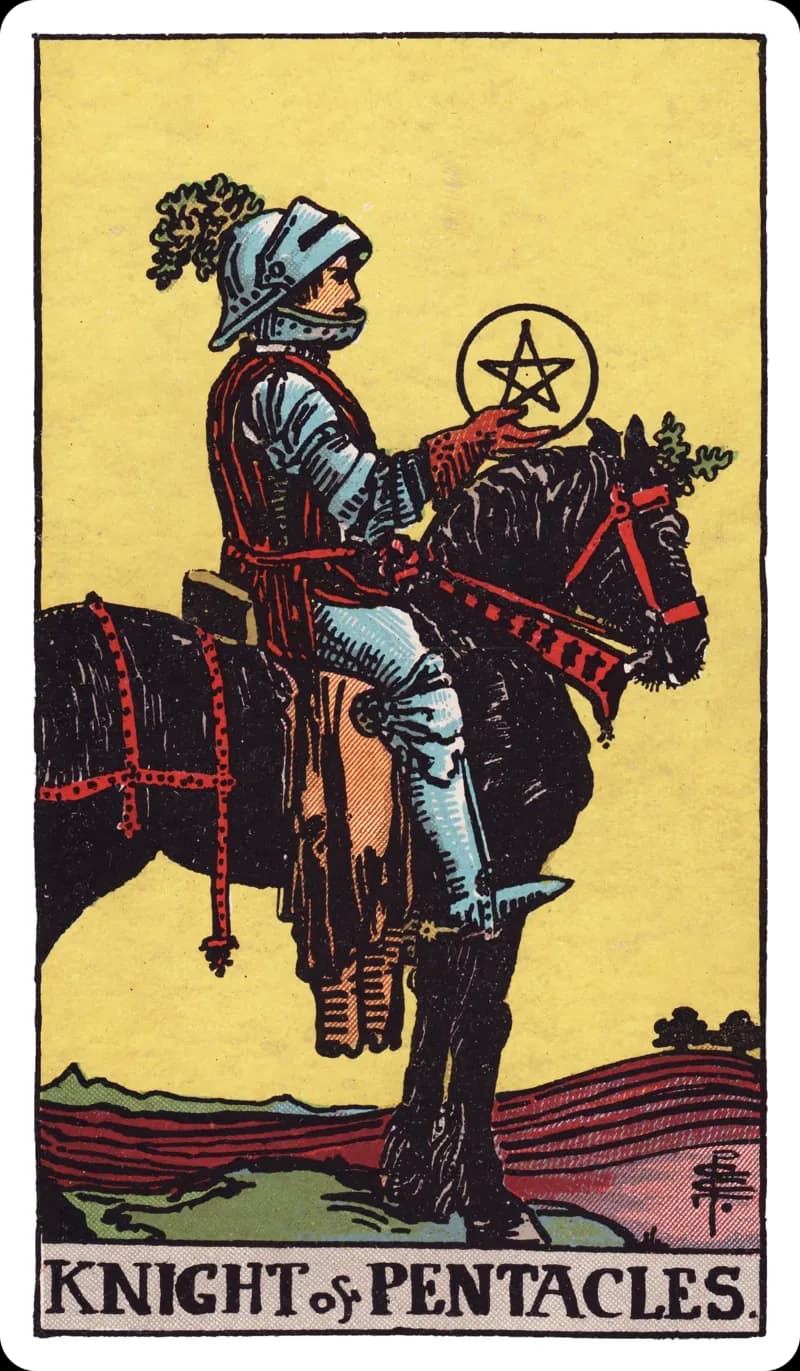
A heavily armored knight sits completely still on a large, dark horse in a plowed field; he holds a single pentacle and examines it steadily, as if calculating rather than preparing to charge; a single tree and vast worked earth fill the background.
Upright vs reversed
| Upright | Reversed | |
|---|---|---|
| Keyword | DILIGENCE | STAGNATION |
Upright meaning
In the Rider-Waite-Smith tradition, the Knight of Pentacles is read as the figure of methodical, unhurried progress — the one who advances slowly and without fanfare precisely because the ground is being tested with every step. Where the other Knights are in motion — charging, floating, galloping — the Knight of Pentacles sits still on a horse that has stopped. This stillness is not timidity; the tradition reads it as the discipline of not moving until movement is warranted. Waite associated the Knights with the active pursuit of their suit's qualities, and in Pentacles that pursuit is one of thoroughness, reliability, and the steady accumulation of practical results. The plowed field behind the knight is the world already worked — the Knight operates in cultivated terrain, not wilderness.
Contemporary RWS practitioners frequently associate the Knight of Pentacles with the archetype of the reliable executor — the figure who does not promise brilliance but delivers results, who reads the fine print, who shows up every day and finishes what was started. The card is often read as an encouragement to trust the slow path: the work that appears undramatic from the outside is building something that will withstand scrutiny. Practitioners also note the card's relationship to sustainability — the Knight's horse is not exhausted, the field is not depleted, and the pace of progress protects the resources required to sustain it.
Reversed meaning
Reversed, the Knight of Pentacles becomes the archetype of stagnation — a thoroughness that has curdled into refusal to move, a risk-aversion so extreme that no decision can ever be reached, or the routine that has become rigidity. The tradition reads this as the virtue of patience taken past its useful limit. Practitioners also read the reversed Knight as a person or situation characterized by dullness, conservatism to the point of obstruction, or a refusal to adapt when circumstances have clearly changed. The work continues, but it no longer serves its original purpose.
In a reading
In the Situation position, the Knight of Pentacles identifies a period of steady, methodical advancement — progress that is real but unhurried, work that is being done carefully and without shortcuts. In the Action position, it counsels patience and thoroughness over speed; the situation rewards those who read the details rather than those who move first. In the Outcome position, it suggests that the current path will produce reliable, durable results if the pace of careful work is maintained.
In combination
The Knight of Pentacles beside The Chariot is read in the RWS tradition as two forms of forward motion set against each other — one urgent and willed, one so measured that the horse has stopped, and the reading usually turns on which pace the situation actually rewards. Paired with the Eight of Pentacles, the two describe the same discipline at different distances: the craftsman at the bench and the rider crossing the field he will work. When the Knight of Pentacles appears with the Four of Pentacles, practitioners often read steadiness hardening into holding — the reliable pace becoming a refusal to move at all, and thoroughness quietly reclassified as fear.
Frequently asked questions
- What does the Knight of Pentacles mean in a love reading?
- In a love reading, the Knight of Pentacles is traditionally read as devotion that shows up rather than announces itself — the partner who is where they said they would be, whose care is legible in what gets done rather than in what gets said. Practitioners often read it as slow courtship: a connection built at a pace that can be sustained. Its shadow is named in the same breath, because the tradition is honest about it — this steadiness can read as absence of passion, and the horse that never breaks into a gallop can leave someone waiting for a feeling to be spoken.
- What does the Knight of Pentacles mean in a career or money reading?
- In career and money questions, the Knight of Pentacles usually names the long, unglamorous middle of an effort that is genuinely progressing — the project being finished, the routine being kept, the details being read. The tradition draws attention to the horse: it is not exhausted, and the field is not depleted, so the pace is one that can be maintained rather than survived. The card offers interpretation, not financial or career advice — it does not promise a return on the patience. It observes that the work is durable, and that durability has its own timeline.
- What does the Knight of Pentacles reversed mean in a reading?
- The Knight of Pentacles reversed is traditionally read as patience taken past its useful limit — thoroughness curdled into refusal, caution so complete that no decision is ever reached, routine hardened into rigidity. Practitioners often read a situation that continues out of momentum after its purpose has gone: the field still being worked, the crop no longer needed. The reversal does not fault the care. It asks whether the circumstances have changed while the method has not.
These notes follow the Rider-Waite-Smith tradition. They describe what the card is associated with — not predictions about your life.