What the card shows
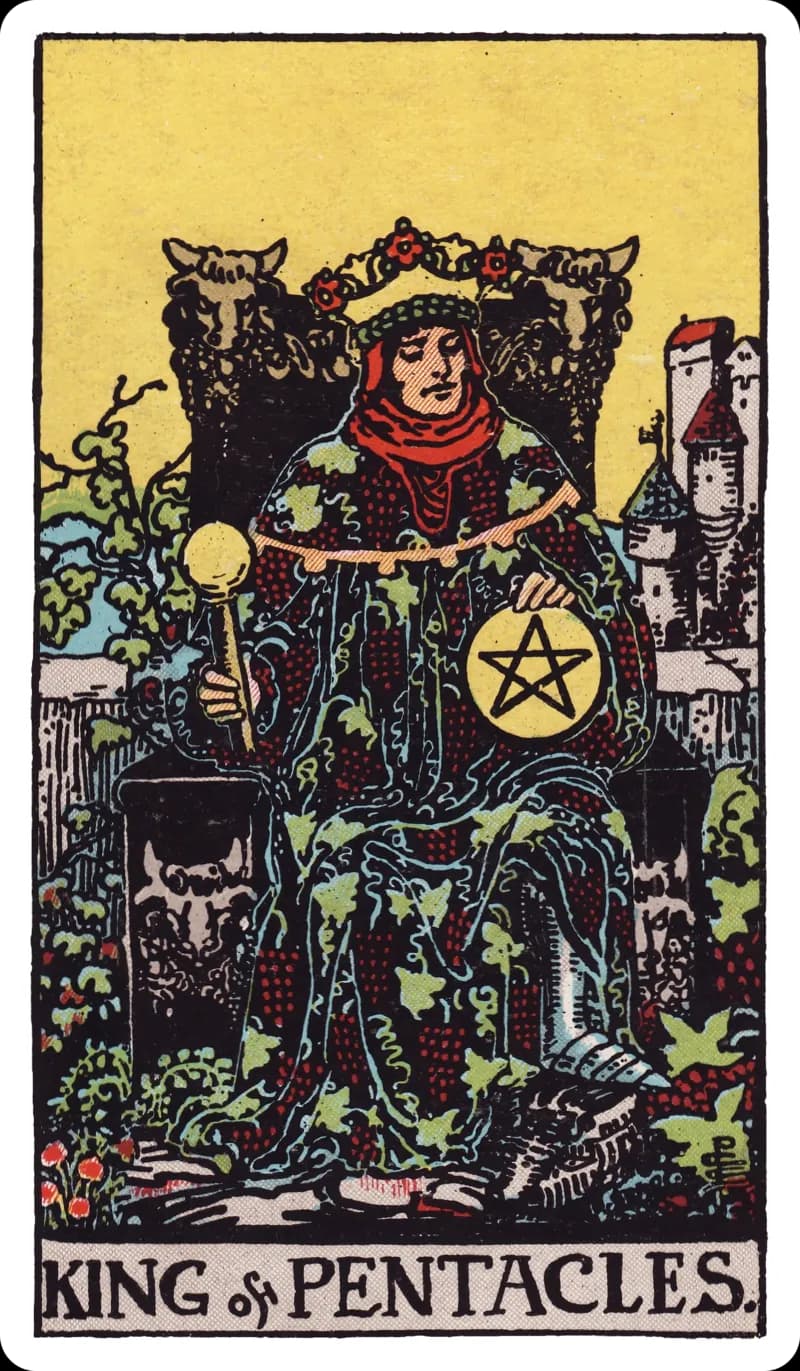
A mature, powerful king sits on a bull-decorated throne in a walled garden, one hand resting on a pentacle at his knee and the other holding a scepter; his robes are richly embroidered with grapes and vines, a castle rises behind him, and the garden around him is in full, ordered abundance.
Upright vs reversed
| Upright | Reversed | |
|---|---|---|
| Keyword | STABILITY | GREED |
Upright meaning
In the Rider-Waite-Smith tradition, the King of Pentacles is read as the figure of achieved material mastery — someone who has not only built wealth but learned how to inhabit it sustainably, and who governs the material domain with the quiet confidence of long experience. Waite associated the Kings with the outer expression of their suit's energy at full development, and in Pentacles that development is an embodied relationship with the physical world: the vines embroidered on his robes, the castle behind him, the walled garden that contains rather than confines. The bull motif on the throne invokes Taurus — patience, sensuality, endurance, and a natural authority rooted in the earth rather than in abstraction. The King does not hold the pentacle tightly; it rests on his knee, fully owned but not anxiously clutched.
Contemporary RWS practitioners read the King of Pentacles as the archetype of the reliable, generous patriarch of the material world — the experienced investor, the successful business owner, the elder who has earned the right to counsel others in practical matters and does so without ego. The card describes someone whose authority comes from demonstrated results rather than inherited title. Practitioners also note the sensory intelligence of the card: the King's garden is not austere but lush, suggesting that material mastery in this tradition is not self-denial but the cultivation of genuine pleasure from what has been built.
Reversed meaning
Reversed, the King of Pentacles describes the corruption of material mastery — a figure whose authority has become domineering, whose financial acumen has turned into exploitation, or whose sensuality has slipped into excess. The tradition also reads this reversal as the misuse of wealth: resources deployed to control rather than to generate, or a material success that has been achieved at the cost of the relationships and values that made it worthwhile. Practitioners sometimes read the reversed King as financial corruption, abuse of institutional power, or a mentor whose practical advice comes with unacceptable conditions.
In a reading
In the Situation position, the King of Pentacles identifies a context shaped by established material authority — a person, institution, or set of conditions that has the weight of proven success behind it. In the Action position, it counsels bringing long-view thinking and practical mastery to the situation: act from experience, not from urgency, and deploy resources with the deliberateness of someone who understands their value. In the Outcome position, it points toward lasting material success, financial security, and the satisfaction of a domain well-governed.
In combination
The King of Pentacles beside The Emperor is read in the RWS tradition as two authorities that are easily confused and rarely the same — one governing by structure and law from a stone throne, the other by soil and demonstrated result from a garden. Paired with the Ten of Pentacles, the reading extends past the man to what survives him: the walled garden becoming the family estate, mastery becoming inheritance. When the King of Pentacles appears with The Devil, practitioners note that the horned throne answers the horned figure — the same material world, once governed and once obeyed — and read the pairing as the question of who is holding whom.
Frequently asked questions
- What does the King of Pentacles mean in a love reading?
- In a love reading, the King of Pentacles is traditionally read as love that arrives as a built life rather than as a spoken feeling — the partner who makes a future materially possible and considers that the declaration. Practitioners read the walled garden as the point: it contains rather than confines, and what grows inside it is genuinely lush. The tradition is candid about the cost. Someone who expresses devotion through provision can be difficult to reach in any other register, and the reading often turns on whether that language is being received as love or merely as comfort.
- What does the King of Pentacles mean in a career or money reading?
- In career and money questions, the King of Pentacles usually names established mastery — authority earned by demonstrated results rather than granted by title, and the long-view thinking of someone who has already been through several cycles. Practitioners often read the presence of a mentor or an institution with real weight behind it. The tradition notes the hand on the pentacle: owned, resting, not clutched. The card offers interpretation, not financial or career advice — it neither values an opportunity nor endorses one. It describes a domain governed with the confidence that only repetition produces.
- What does the King of Pentacles reversed mean in a reading?
- The King of Pentacles reversed is traditionally read as material mastery curdling — authority turned domineering, financial acumen turned extractive, sensuality slipped into excess. Practitioners often read the mentor whose practical help arrives with conditions attached, or resources deployed to control rather than to generate. The reversal is also read as success that cost the relationships and values that made it worth having. The garden is still walled. What has changed is whether the wall is holding something in or keeping someone out.
These notes follow the Rider-Waite-Smith tradition. They describe what the card is associated with — not predictions about your life.