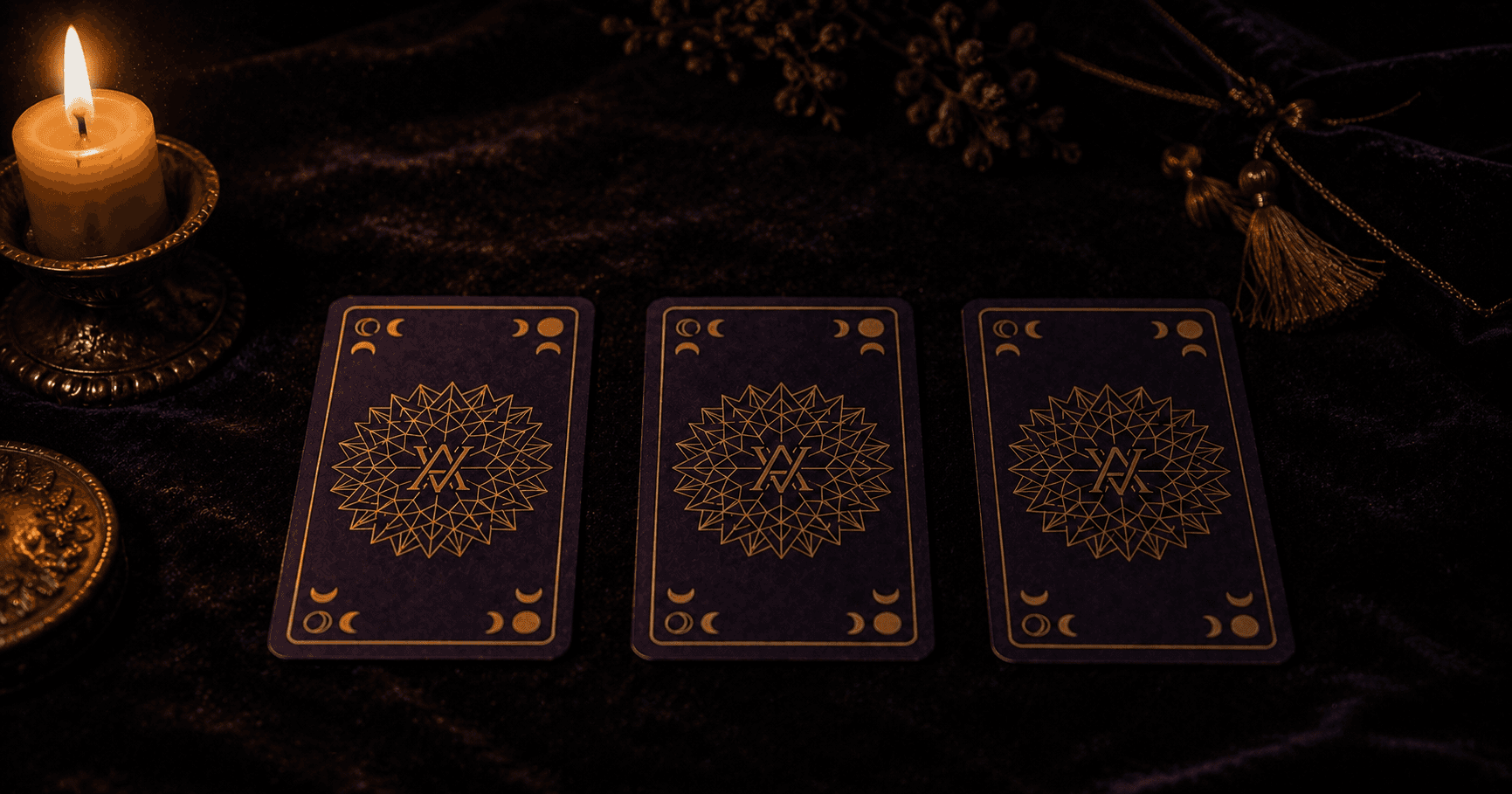
The three-card spread is the simplest serious tarot reading. Three cards, three positions, one short story. Practitioners have used several variants for centuries — past / present / future, mind / body / spirit, and the version Vidastral defaults to: situation, action, outcome. The compactness is the point. There is no room to drift, and the structure asks the reader to do the work that matters most: connect three small archetypes to the actual question they came to ask.
This post walks through the situation / action / outcome variant in the Rider-Waite-Smith tradition. It is meant for someone who has just received a reading and wants to know what kind of object they are looking at, or for someone who is about to draw cards and wants a clearer frame than "general guidance."
What the spread is
Three cards are drawn at random from a 78-card Rider-Waite-Smith deck without replacement. Each card may be upright or reversed. The cards are then placed in three fixed positions, in this order: situation, action, outcome. The spread is data — the meaning is not in the draw itself but in the relationship between the cards and the positions.
Position one, situation, frames where the reader stands today: the conditions they are operating in, the soil the question is growing out of. Position two, action, asks what the cards suggest about approach or response. Position three, outcome, points toward where the cards lean given the prior two. None of these is a prediction. The third card is a direction the cards point toward, not a verdict on the future.
How to read it
Read the three cards as one piece, not three. The first card sets the ground; the second proposes a posture in that ground; the third is the trajectory that follows when the first two are taken seriously. A reading often turns when a single card reframes the others — for example, the Tower in the situation position changes what "action" means in any card that follows.
Reversals are not simply opposites. In the Rider-Waite-Smith tradition, a reversed card carries its own interpretive layer — often a blocked, internalized, delayed, or shadow-side expression of the upright meaning. A reversed Star is not the absence of hope; it is hope that is being avoided, dimmed, or refused. Treat reversals as named when they appear, not glossed over.
Major Arcana cards (the 22 numbered cards from The Fool through The World) are typically read as larger forces and turning points — themes that organize a chapter rather than describe a moment. Minor Arcana cards (the 56 suit cards: Wands, Cups, Swords, Pentacles) are usually read as the texture of daily life — tasks, feelings, conversations, resources. A reading made entirely of Majors is often interpreted as one in which the larger pattern is more important than the details.
What the spread cannot tell you
Tarot is interpretive, not predictive. A three-card spread will not tell you the name of a future partner, the exact date of an offer, or whether a specific person is thinking about you. Honest tarot — including the kind Vidastral generates — refuses to fabricate these specifics, because the cards do not contain that information and any reader who claims they do is filling in the blanks with confident invention. What the spread can do is offer three small archetypes for you to map against your own situation, and to listen to which of them resonates.
Consider whether any of these themes resonate with your own experience. Tarot is a reflective practice more than a predictive one, and the value of a reading lies in what you recognize of yourself in it.
If you are about to draw a three-card spread for the first time, the most useful thing you can bring is a real question. Vague questions produce vague readings. "Will I be happy?" is too wide to read against; "What is my current relationship to my work, and what does the next chapter ask of me?" gives the cards three clean positions to land in. The cards do not know your life. You do. The spread is a frame for thinking about it more carefully.