The Star arrives in the Major Arcana at number seventeen, and the number that comes before it matters. Card sixteen is The Tower — lightning strike, collapse, the crown knocked from the top of a structure you may have believed was permanent. The Star does not erase what The Tower brought. It comes after. That sequence is part of what the card carries, and reading The Star without that context means missing something essential about its weight.
What the image shows
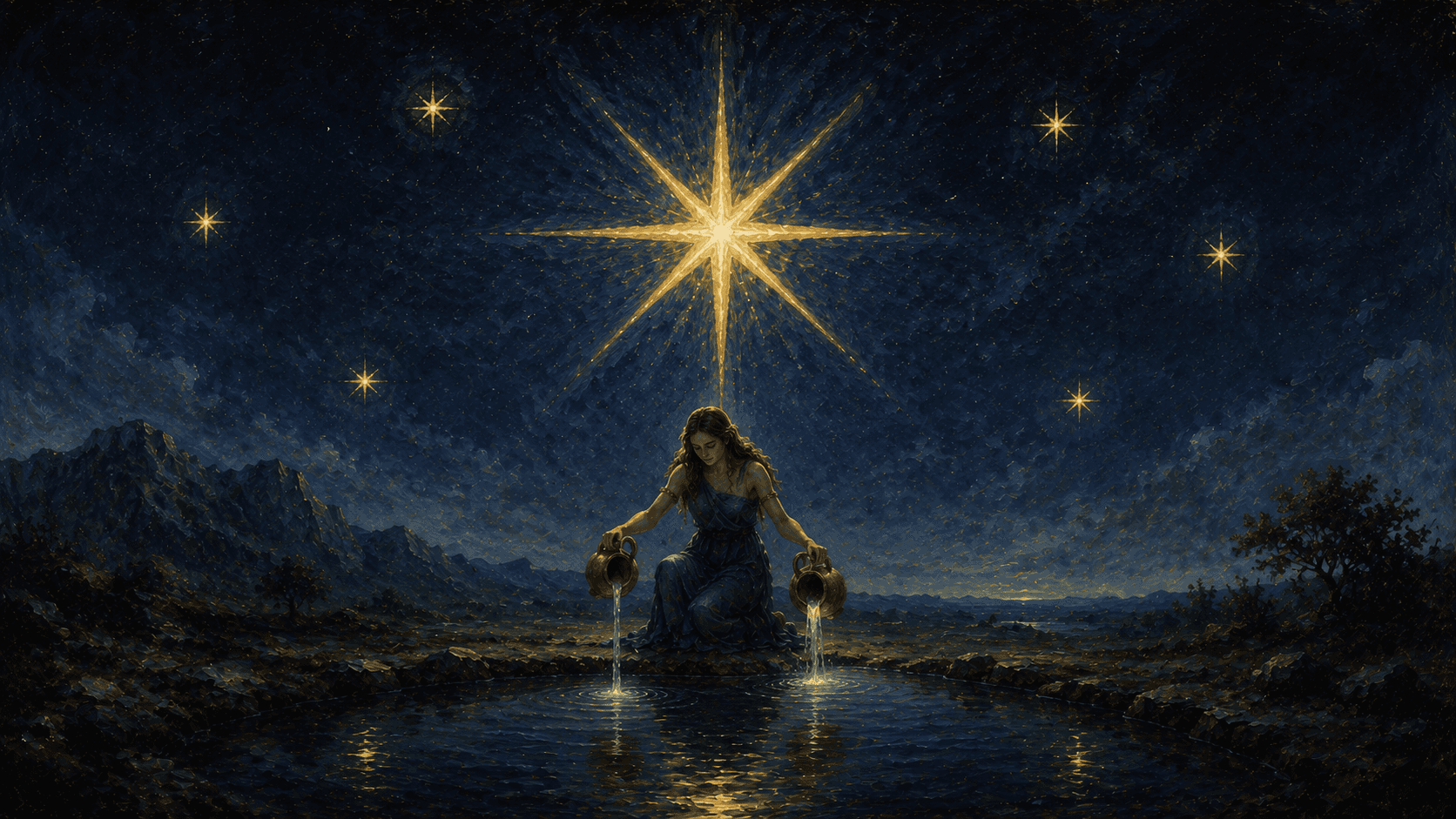
In the Rider-Waite-Smith illustration, a figure kneels at the edge of a pool, naked and unhurried. She holds two vessels — one pours water back into the pool, the other pours onto the dry land beside her. Above her, a single large eight-pointed star dominates the sky, surrounded by seven smaller stars of the same shape. There is no storm in this image. There is open sky, still water, bare ground being slowly fed. The nakedness of the figure is traditionally read as openness — no armor, no pretense, no protective layers between self and circumstance. She is simply present, and she is pouring.
The two vessels are significant. Water going into the pool and water going onto land suggests that restoration is happening on multiple levels simultaneously — inner and outer, emotional and practical. Neither is neglected. This is not a card of dramatic action. The figure is not striding forward or gesturing toward the horizon. She is kneeling, and she is steady, and that steadiness is the whole point.
The Star upright: what this card reflects in a reading
When The Star appears upright in your reading, the Rider-Waite-Smith tradition associates it with renewal, restored faith, and a particular kind of calm that only exists on the other side of difficulty. This is not naive optimism — it is the quieter, more earned version of hope that comes when something hard has already happened and you are still here. The card suggests that a period of openness is available to you. Not a resolution exactly, but a softening. A moment when the ground beneath you is still enough that restoration can begin.
The Star doesn't promise that everything is fixed. It reflects a moment when you are no longer in the storm — and that distinction is worth sitting with.
In a position addressing your emotional state or inner life, The Star often points to a reconnection with something you thought you had lost — not a person or a situation necessarily, but a capacity. The ability to feel interested in the future. The willingness to pour water onto ground that has been dry, without demanding immediate results. In a position addressing external circumstances, the card can reflect conditions that are finally stable enough to allow that kind of tending. The timing feels less urgent. The crisis mode has passed.
The Star reversed: exhaustion before restoration
The Star reversed is not the opposite of hope — it is something more specific and more human than that. In the Rider-Waite-Smith tradition, the reversal is often read as disconnection from restoration: the recognition that healing is theoretically available, but you cannot quite reach it yet. Think of the figure in the image, but with her vessels held stiffly, the water not flowing easily. Not withheld out of bitterness — more like the hands are tired.
Spiritual fatigue is one way to describe what this card can reflect when reversed. A kind of numbness that isn't despair but isn't openness either — something in between, where you know you are supposed to feel the relief but you don't quite, not yet. This reading asks for acknowledgment before it asks for action. The reversed Star can be an invitation to notice that exhaustion honestly, without rushing past it toward a recovery that hasn't fully landed. The water is still there. The pool is still there. The timing is just different.
How position in the spread shapes the meaning
Where The Star falls in a spread changes what it emphasizes. In a past position, it can speak to a period of restoration that has already done its work — something that quietly healed in the background while your attention was elsewhere. In a present position, it often reads as an invitation: the conditions for renewal are here, even if you haven't fully recognized them. In a future position, it suggests that a calmer stretch is a real possibility, though the card doesn't specify when or guarantee the path. Treat it as a directional note, not a fixed destination.
In a crossing or challenge position, The Star can be quietly complex. Sometimes what challenges us is not an obstacle but an opening we're not ready to step into — the vulnerability required by real restoration, the discomfort of lowering defenses that kept us upright during harder times. In that position, the card might be asking what is standing between you and the willingness to be, even briefly, unhurried and unguarded.
What The Star asks of the reading
The Star is not an action card. It doesn't point toward a decision or a next move. It is a card of atmosphere — a particular quality of stillness and openness that the Rider-Waite-Smith tradition marks as significant after disruption. When it appears in your reading, the most useful question may not be what to do, but what you are willing to let in. The figure in the image isn't waiting for something to arrive. She's already pouring. The act of restoration is already underway, quietly, without announcement. That is the card's essential posture — and it is one worth recognizing when it shows up in your spread.