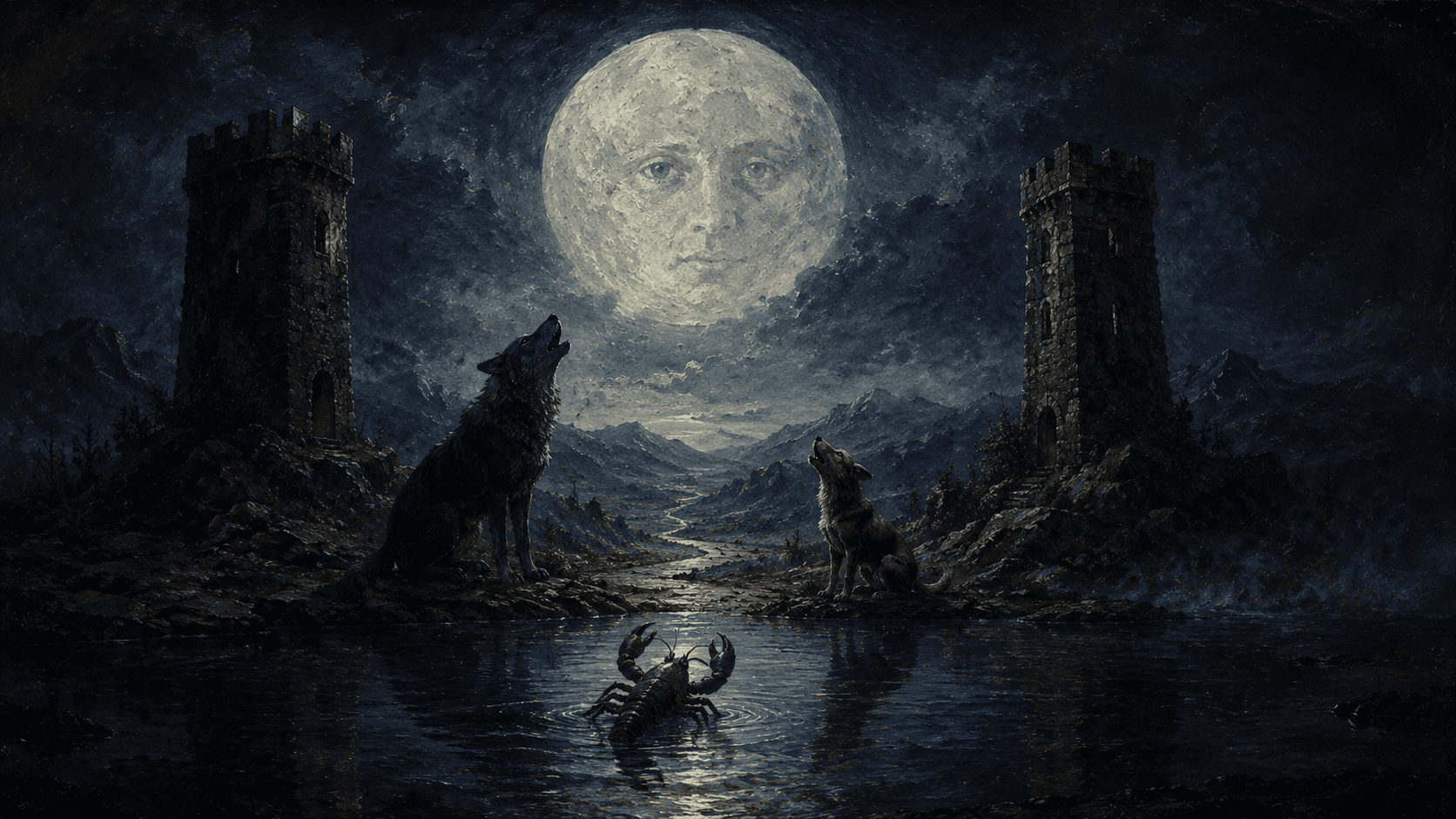
When The Moon appears in a position tied to love or relationship, the first thing to notice is what the Rider-Waite-Smith illustration actually shows: not romance, not warmth, not two figures reaching toward each other. Instead, a solitary path winds between two identical towers under a large, full moon whose face gazes down with an expression that is neither kind nor cruel — only watching. A dog and a wolf stand on either side of the path and howl upward. A crayfish drags itself out of a dark pool at the bottom of the image. The scene is quiet, but the quiet is the kind that comes before something you haven't yet identified.
That atmosphere is the interpretive core of The Moon in a love reading. The card does not point to deception in a simple, accusatory sense. It points to the more uncomfortable truth that in matters of the heart, clarity is often the last thing to arrive — and sometimes what we're most afraid to look at is something we ourselves are generating.
The gap between what you feel and what you know
In the RWS tradition, The Moon is associated with the space between conscious perception and what lies beneath it. In a love reading, this shows up as the experience of not quite being able to read a situation — sensing something is present without being able to name it. You may feel drawn to someone but unsure whether the pull is grounded in genuine connection or in something you're projecting onto them: a quality you want them to have, a version of them that feels safer or more romantic than the actual person.
This is not a card that calls you naive. It is a card that points to the difficulty of seeing clearly when emotional stakes are high. The two towers on either side of the path look identical — the card doesn't tell you which way leads forward. That ambiguity is the message. If The Moon appears when you're asking how someone feels about you, the reading is less likely to reveal an answer than to suggest that the information available to you right now is incomplete, filtered, or obscured by your own hope or fear.
The Moon does not confirm or deny what you suspect. It holds a lantern over the question itself, illuminating how much is still in shadow.
Fear, intuition, and the difference between them
One of the most significant tensions the card raises in a romantic context is the distinction between fear and intuition — two things that can feel almost identical when you're inside them. The crayfish emerging from the pool in the RWS image is often interpreted in the tradition as something rising from the subconscious, moving from the depths toward the surface. In a love reading, that image can speak to the slow, uncomfortable process of letting yourself acknowledge what you already sense but haven't been willing to examine directly.
If you find yourself replaying conversations, reading tone differently each time you remember it, or constructing alternate interpretations of the same behavior, The Moon may be reflecting that loop back to you. The question the card invites is not "what is the truth?" — it's "what are you afraid the truth might be, and is that fear informing how you're seeing things?" Neither the dog nor the wolf in the image has a clear answer. Both are simply responding to the same light.
What The Moon upright suggests in a relationship reading
When The Moon appears upright in a position representing a relationship or a person, the RWS tradition suggests that something remains unsurfaced. This can apply to an early-stage attraction where you genuinely don't yet know how the other person feels, and the uncertainty itself has taken on a weight. It can also appear in an established relationship when there's a topic neither person is addressing directly — not necessarily because of bad intent, but because it hasn't found language yet, or because the emotional cost of naming it feels too high.
The card here is not a warning so much as an invitation to sit with the discomfort rather than resolve it prematurely. The moonlit path does have a destination — the sun rises in the distant background of the RWS image — but that sunrise is not yet visible from where the crayfish stands. Forcing clarity before it's available often produces a false version of it. The Moon upright in a love reading can be asking you to tolerate not knowing, and to notice what that not-knowing is teaching you about what you actually want.
The Moon reversed: when the fog begins to thin
Reversed, The Moon in the RWS tradition is not simply the opposite of confusion — it doesn't mean everything is suddenly clear. What a reversal tends to suggest is that the illusion is beginning to dissolve, or that you are starting to see through it. In a love reading, this can point to a moment of recognition: something that was murky about a person or a dynamic is becoming legible. The crayfish, in a sense, has made it further up the bank.
This can be a relief, but the tradition also acknowledges that what emerges from the pool is not always what you hoped for. The Moon reversed sometimes indicates that a fear you had about a relationship was more grounded in reality than you allowed yourself to believe — or, equally, that a fear was unfounded, and you're only now able to see that the anxiety was yours to carry rather than a signal about the other person. Both are meaningful. Both require you to do something with the clarity once it arrives.
Reversed, The Moon asks what you do with honesty when it finally surfaces — whether the truth is harder or gentler than you anticipated.
Sitting with The Moon in a love reading
What makes The Moon particularly resonant in love readings is that emotional confusion is not a flaw in the process — it is often the process. The card doesn't ask you to wait passively for fog to clear. It asks you to look carefully at what you are contributing to the cloudiness: the assumptions you're making, the conversations you're avoiding, the version of the other person you've constructed from limited information. The dog and the wolf both howl at the same moon, but one is domesticated and one is not — the difference between the two is in how well you know them, not in the light they're both responding to. In a reading about love, that distinction matters.