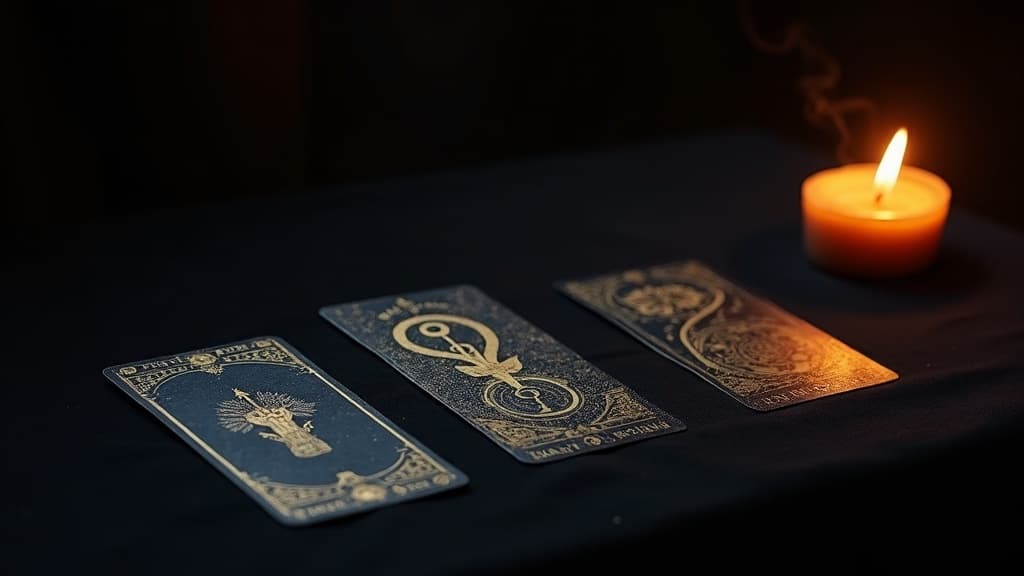
Vidastral reads tarot interpretively, not predictively. Every reading draws three cards — Situation, Action, Outcome — and interprets them in the Rider-Waite-Smith tradition as a structured mirror for reflection. The reading names patterns already present in the question you brought; it does not forecast events, reveal what another person is thinking, or announce what will happen. That single distinction shapes everything about how a Vidastral reading is written, from the spread to the closing line.
What is an interpretive tarot reading?
An interpretive reading treats the cards as archetypes to think with rather than as messages about a fixed future. Each card in the Rider-Waite-Smith deck is a compressed image of a human pattern — sudden upheaval in The Tower, unsurfaced confusion in The Moon, renewal after difficulty in The Star. When one of those images lands in your spread, the reading asks what the pattern illuminates about your situation right now: what it resembles, what it resists, what it invites you to consider.
A predictive reading works from the opposite assumption — that the future is already written and the cards leak it. That version asks nothing of you, which is its appeal and its dishonesty in one. An interpretive reading keeps your agency at the center: the cards contribute a vocabulary, and you supply the recognition. Nothing in the deck knows your future. What the deck holds is more than a century of imagery about how human situations tend to move, which is a different — and more useful — kind of knowledge.
How does the Situation / Action / Outcome spread work?
Every Vidastral reading uses the same three positions. The Situation card names the pattern at the center of your question — the shape of what is actually happening, which is not always the shape you described when you asked. The Action card speaks to what the moment asks of you: a stance, an adjustment, a conversation you may have been circling. The Outcome card is the one most often misread, so it deserves its own sentence: it describes the trajectory of the present pattern, not a guaranteed event.
Read that way, an Outcome card like The Star does not promise that relief is scheduled to arrive. It suggests that the current of the situation, as the first two cards describe it, bends toward renewal — and that the renewal depends on the action position being taken seriously. The three cards form a small narrative you can test against your own experience, which is something a verdict can never be.
The Outcome position describes where the present pattern is pointing, not where you are fated to arrive. A trajectory can be redirected — that is the entire point of reading it.
Why doesn't Vidastral predict the future?
Because prediction requires invention. The deck contains archetypes; it does not contain names, dates, diagnoses, or the contents of another person's mind. Any reading that offers those specifics is supplying them from somewhere other than the cards. Vidastral's readings are deliberately constrained against that overreach: they do not fabricate details about your life, they do not claim to know what someone else feels, and every interpretation is attributed to the Rider-Waite-Smith tradition rather than presented as hidden fact.
There is also a quieter reason. A predicted future is something that happens to you; an interpreted present is something you can work with. When a reading says "this will happen", the only available response is to wait. When a reading says "this is the pattern, and here is what it asks of you", the response belongs to you. Vidastral is built on the second kind of reading because it is the kind that leaves you more capable than it found you.
What does a Vidastral reading actually sound like?
Plain prose. Five paragraphs, no jargon, no theatrical mystery. The reading opens with the situation as the cards frame it, moves through each position, and closes with something to carry rather than an instruction to obey. Its register is interpretive throughout — "this card invites you to consider", "in this position, the tradition reads this as" — never "this means you will". If a question invites a yes or a no, the reading will lean, honestly, but it names what the lean depends on rather than issuing a verdict.
The question you bring matters as much as the cards you draw. A question phrased as "will it happen?" asks for a prophecy the cards cannot give; the same concern phrased as "what is my relationship to this, and what does it ask of me?" gives the spread something real to work on. The reading meets you at the level of the question — which is why the most useful readings tend to begin before any card is drawn, in the moment you decide what to ask.
A reading that admits it cannot see your future is not a weaker reading. It is the only honest one — and honesty is what makes the reflection worth trusting.
None of this makes the reading less resonant — restraint is what makes the resonance trustworthy. A card like Death can still stop your breath for a moment when it lands in the Situation position; the difference is that the reading will name what the tradition actually sees there — an ending already underway, making room for what follows — instead of pretending to see your future in it. What you meet in a Vidastral reading is not a fortune. It is a mirror, angled carefully, held steady long enough for you to recognize what was already looking back.